


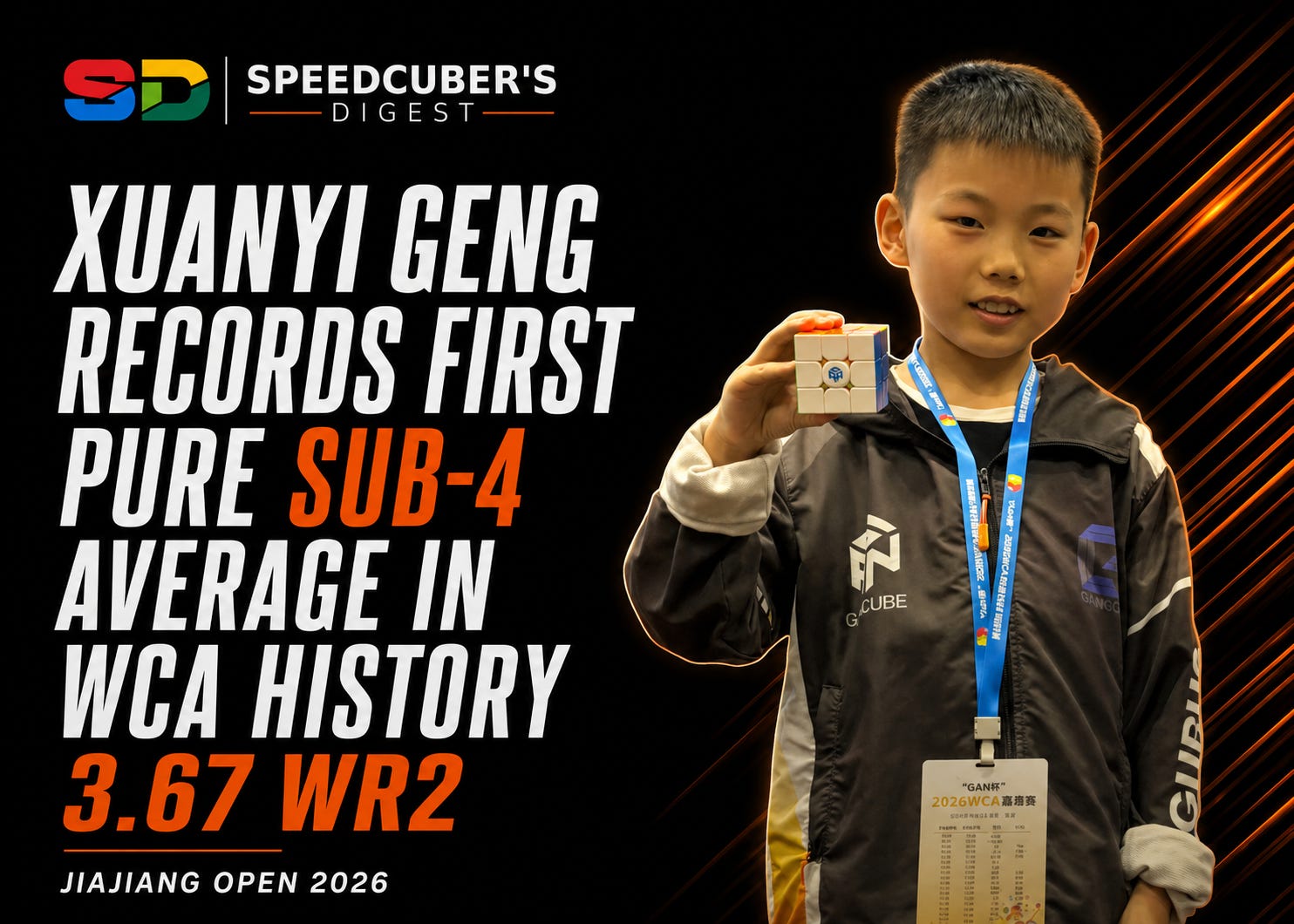
The last time we wrote about Xuanyi Geng, the story was consistency.
At Nanchang Summer 2026, Geng recorded a straight mean of 4.39 seconds across 20 official solves. Eighteen were below five seconds, and he won both the semifinal and final, but he left without improving either of his personal records.
At Jiajiang Open 2026, that consistency finally produced a historic result.
Geng won all four rounds of 3x3 with the following solves:
First round: 4.02, (3.76), 4.31, (5.31), 4.57 = 4.30
Second round: 4.00, (5.48), (3.73), 4.40, 4.66 = 4.35
Semifinal: 4.25, (3.82), 4.38, 5.15, (5.22) = 4.59
Final: (3.85), 3.70, (3.28), 3.78, 3.52 = 3.67
His straight mean across all 20 solves was 4.26 seconds, approximately 0.13 faster than his performance at Nanchang.
The defining moment came in the final.
Geng opened with a 3.85 before following it with a 3.70, 3.28, 3.78 and 3.52. After removing the fastest and slowest solves, the remaining three produced a 3.67 average.
Once processed, the result should rank second in the world behind Yiheng Wang’s 3.51 world record. It also improves Geng’s previous personal best of 3.71, which briefly held the world record earlier this year.
The ranking, however, is only part of what makes the average historic.
Every solve in the set was below four seconds. In fact, every solve was below 3.9 seconds, with the discarded 3.85 standing as the slowest of the five.
That makes Geng’s result the first pure sub-4 average in WCA history, as well as the first pure sub-3.9 average.
A “pure” average means every solve clears the milestone, including the two attempts removed from the official calculation.
Wang’s 3.51 world record included a 4.61. Geng’s previous 3.71 contained a 4.33, while his 3.74 included both a 4.12 and a DNF. Every other official sub-4 average also contained at least one solve of 4.00 or slower.
Geng’s set had no such weakness.
The straight mean of his five final solves was 3.626 seconds, lower than the 3.708 straight mean of Wang’s world-record set:
Wang: 3.68, (4.61), (3.39), 3.41, 3.45 = 3.51
Geng: (3.85), 3.70, (3.28), 3.78, 3.52 = 3.67
That does not make Geng’s result the world record. WCA averages remove the fastest and slowest attempts, and Wang’s three counting solves remain faster.
It does show the unusual nature of Geng’s performance. Wang produced the stronger three-solve core, while Geng produced the faster full set from beginning to end.
At Nanchang, Geng showed almost no weakness across an entire competition. At Jiajiang, he compressed that consistency into five solves and became the first competitor in WCA history to complete an entire official average below four seconds.