


I spent most of this past weekend watching the European Championship.
That was understandable. Euros brought nearly 1,200 competitors together in the Netherlands, Poland won 11 of the 17 continental titles, and some of the best speedcubers in the world competed under championship pressure.
But one of the results that may tell us the most about the next few years of speedcubing happened thousands of miles away at Nanchang Summer 2026.
The competition brought together eight Chinese competitors ranked inside the world’s top 12 by 3x3 average: Xuanyi Geng, Zhaokun Li, Yufang Du, Bofan Zhang, Ruihang Xu, Yize Dong, Qixian Cao, and Yi Shen.
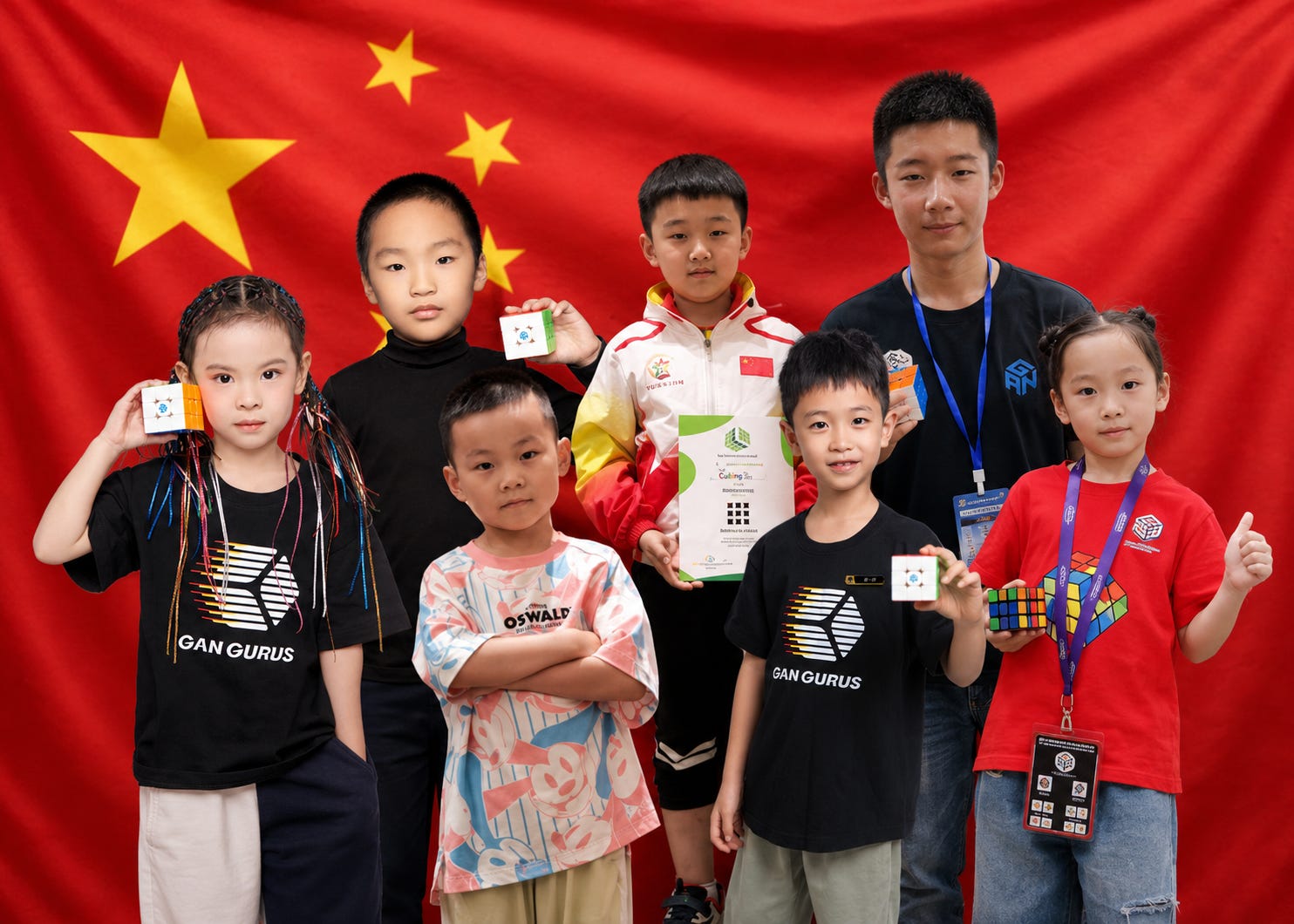
Their nationality is not the only striking similarity. Many are 12 years old or younger, meaning a significant portion of the world’s fastest 3x3 field is made up of Chinese children who have not yet reached their teenage years.
Shen may be the clearest example of how quickly the group is still developing. He attended his first official competition in January and has already risen to eighth in the world by average.
Nanchang was not an average competition by global standards. By Chinese standards, however, a room containing this many young, world-class competitors is beginning to feel less unusual.
The Headline Was Not One Result
Xuanyi Geng won 3x3 with a 4.28 average, followed by Ruihang Xu at 4.65 and Zhaokun Li at 4.98. Bofan Zhang added a 16.97 4x4 single national record, while Zhen Chen set the Chinese One-Handed single record at 6.47.
Those would be the headline results at almost any competition.
They were only part of the story in Nanchang.
Earlier in 3x3, Zhang stopped the timer at 2.72 seconds. He had finished one move away from solved, resulting in a +2 penalty and an official time of 4.72. Without the penalty, it would have broken Teodor Zajder’s 2.76 world record by 0.04 seconds.
Yufang Du recorded a 4.36 personal-best average in the first round.
Yunzhi Lian then averaged below five seconds twice, recording a 4.92 in the second round and a 4.89 in the semifinal. The semifinal set included solves of (5.63), 5.10, 5.22, (4.26) and 4.36, making her only the second female competitor to officially average below five seconds.
Yi Shen also set personal-best averages in consecutive rounds. He recorded a 4.58 in Round 2 before lowering it again to 4.51 in the semifinal, where he finished second behind Geng.
Shen’s four-round progression was 4.73, 4.58, 4.51, and 5.40. He did not have the strongest final, but the two personal bests moved him to eighth in the world only months after entering his first official competition.
Yize Dong recorded a 4.60 average in the semifinal. Ruihang Xu produced a 4.65 personal best in the final. Zhang’s 4x4 record and Chen’s One-Handed record showed that the depth was not limited to standard 3x3.
The individual results were exceptional. What made the competition significant was how many different people produced them, including someone whose competitive career began only six months ago.
This was not one Chinese superstar carrying an otherwise ordinary field. It was a group of elite and emerging competitors repeatedly pushing one another through four rounds.
Xuanyi Geng’s Quietly Ridiculous Competition
Geng did not set a personal record in Nanchang.
At his level, that is not surprising. His 3.71 average previously stood as the world record and remains second globally. His 2.80 single is also ranked second in the world. A new personal best for Geng will almost always require a result at or near world-record level.
What he produced instead may be more useful when looking ahead to future championships.
Across four rounds and 20 official solves, Geng’s times were:
Round 1: (5.07), (3.80), 4.62, 4.49, 4.00
Round 2: 4.83, 4.62, (5.23), (4.28), 4.72
Semifinal: 3.86, 4.19, (4.58), (3.48), 4.30
Final: 4.46, (4.03), (4.81), 4.29, 4.10
The straight mean of those 20 solves was 4.388 seconds.
Eighteen of the 20 were below five seconds. Only the 5.23 and 5.07 crossed that mark. He won the semifinal with a 4.12 and the final with a 4.28.
There was no world record and no personal best, but there was almost no weakness either.
That type of consistency matters in a way that rankings sometimes fail to show. World records are decided by one great set. Major championships require a competitor to survive round after round, often while dealing with pressure, long waits and a room full of other contenders capable of winning.
With the next World Championship less than a year away, Geng looks increasingly prepared for that environment.
China’s Depth Is Becoming Difficult to Compare
Bofan Zhang finished seventh in the 3x3 final with a 5.41 average. That exact result would have won both continental championships held earlier in July. Teodor Zajder won Euros with a 5.46, while Kyle Santucci won the North American Championship with a 5.63.
A 5.41 was fast enough to win either continental championship. At Nanchang, it placed seventh.
Zhang did not have a bad competition. He reached four rounds, set a 4x4 national record, and came one move away from the 3x3 single world record. Yet in this particular Chinese field, a championship-winning average elsewhere was only enough for seventh.
The world rankings show the same pattern. At the time of publication, eight of the top 10 competitors by 3x3 average represent China, as do 13 of the top 20. Teodor Zajder and Tymon Kolasiński are the only non-Chinese competitors inside the top 10, while the highest-ranked American has fallen to 12th.
Only Matty Hiroto Inaba, Max Park, and Luke Garrett have recorded official sub-5 averages while representing the United States. Garrett is the only one of the three to have done it twice. For several of China’s leading competitors, meanwhile, five seconds is no longer a career-defining barrier. It is an average they expect to beat regularly.
Poland Just Showed Us What Density Can Create
The timing of Nanchang made the broader point difficult to ignore.
At the same time Nanchang was happening, Poland was dominating the European Championship. Polish competitors won 11 of the 17 European titles and earned medals across every standard cube event.
That did not happen because Poland developed one great competitor.
Tymon Kolasiński won 4x4, 5x5, 6x6 and 7x7. Teodor Zajder won 2x2 and 3x3. Antoni Stojek won Clock, Adrian Dębski won 3BLD, Krzysztof Pietrusiak won Fewest Moves, Michał Krasowski won Square-1, and Jakub Majchrzak became the European Pyraminx champion.
Different competitors succeeded in different events, but they came from the same thriving national community.
Poland’s advantage is not simply that Tymon and Teodor are extremely fast. It is that the country has enough depth for its best competitors to regularly practice, compete, and exchange knowledge with people operating near their level.
Nanchang showed the Chinese version of that effect.
The difference is scale.
China has a much larger population and an increasingly concentrated pool of young elite competitors. Yiheng Wang is already the reigning world champion and holds the 3.51 average world record. Geng sits directly behind him at 3.71. Zhang, Du, Li, Cao, Dong, Xu, and Shen give the country an expanding group capable of producing top-level results without the competition needing to be a national or continental championship.
Population alone does not create elite speedcubers. Access does. Repetition does. Coaching, competition, equipment and strong peer groups do.
China is increasingly building all of those at once.
A Competition System That Keeps Expanding
The official WCA calendar is only one part of China’s speedcubing ecosystem.
GAN’s Smartcubing Super League has developed into a large spectator-focused competition series. Its fourth season brought together more than 300 participants, major international names and team-based formats designed for an audience rather than only for official rankings.
GAN has also been selected as the equipment provider for China’s 2026 National Speedcubing Series following an evaluation by the Social Sports Administration Center of the General Administration of Sport of China. The partnership includes competition cubes, timers, mats and athlete equipment packs, with the stated goal of standardizing competitions and expanding speedcubing’s reach.
Speedcubing has also been added to the Asian Mind Sports Association’s group of disciplines alongside chess, Go, bridge and other established mind sports. Its 2026 festival was held in Hong Kong and included speedcubing as part of a wider international mind-sports program.
This does not mean every competition or program directly produces a world-class solver.
It means competitors have more entry points.
A young cuber can discover the sport through a school event, compete locally, join an online or smart-cube league, receive manufacturer support, and enter WCA competitions without each step requiring the same level of travel or personal organization seen in smaller communities.
The competition frequency matters too.
Cubing China’s upcoming calendar includes events across Beijing, Shanghai, Guangzhou, Maoming, Zhanjiang, Hefei, Nanning, Beihai and Xi’an. It also includes the Guangzhou GraDUAL series, with its first 3x3 event scheduled for a Wednesday rather than a traditional weekend.
More competitions mean more official attempts. More importantly, they mean more time spent in competition conditions.
The result is a feedback loop. Better competitors create stronger fields. Stronger fields attract attention, sponsorship and new cubers. Those cubers then enter a system where world-class solving is no longer distant or abstract. It may be happening at the next table.
The Most Important Result May Be How Normal It Felt
Nanchang Summer was a one-day competition with a 180-person limit.
It produced a 4x4 national record, a One-Handed national record, a near-world-record 3x3 single, two sub-5 averages from the second-fastest female competitor in history, and four rounds of remarkable consistency from the former world record holder.
Xuanyi Geng won with a 4.28, but the competition was not only about Xuanyi Geng.
That is the central point.
The depth is no longer visible only in individual rankings. It is showing up in entire podiums.
Nine of the 10 fastest 3x3 podiums currently listed by WCA Statistics were recorded at competitions in China. Nanchang’s podium of Geng at 4.28, Xu at 4.65, and Li at 4.98 combined for 13.91 seconds, still leaving it just outside that group.
Even that podium does not fully represent how fast the room was. Shen recorded a 4.51 in the semifinal, Dong produced a 4.60, Du recorded a 4.36 personal best, and Zhang already owned a 4.38.
Chinese speedcubing is no longer defined by a single generational talent. Yiheng Wang and Geng may currently sit at the top, but the group behind them is becoming too deep to treat as supporting cast.
Zhang can stop the timer below the world record. Du owns a 4.36 personal-best average. Shen reached 4.51 within months of beginning his competitive career. Lian went below five twice in one competition. Dong and Xu are producing mid-4 averages. Chen is setting national records in One-Handed.
And another competition is always approaching.
Poland showed at Euros what can happen when a dense, competitive community develops multiple specialists at the same time. China appears to be building something similar on a considerably larger foundation, with eight of the current top 10 averages and enough depth for a continental-title-winning result to place seventh at a one-day competition.
We are already seeing the results.
Nanchang suggests we are still much closer to the beginning than the limit.
Absolute peak