


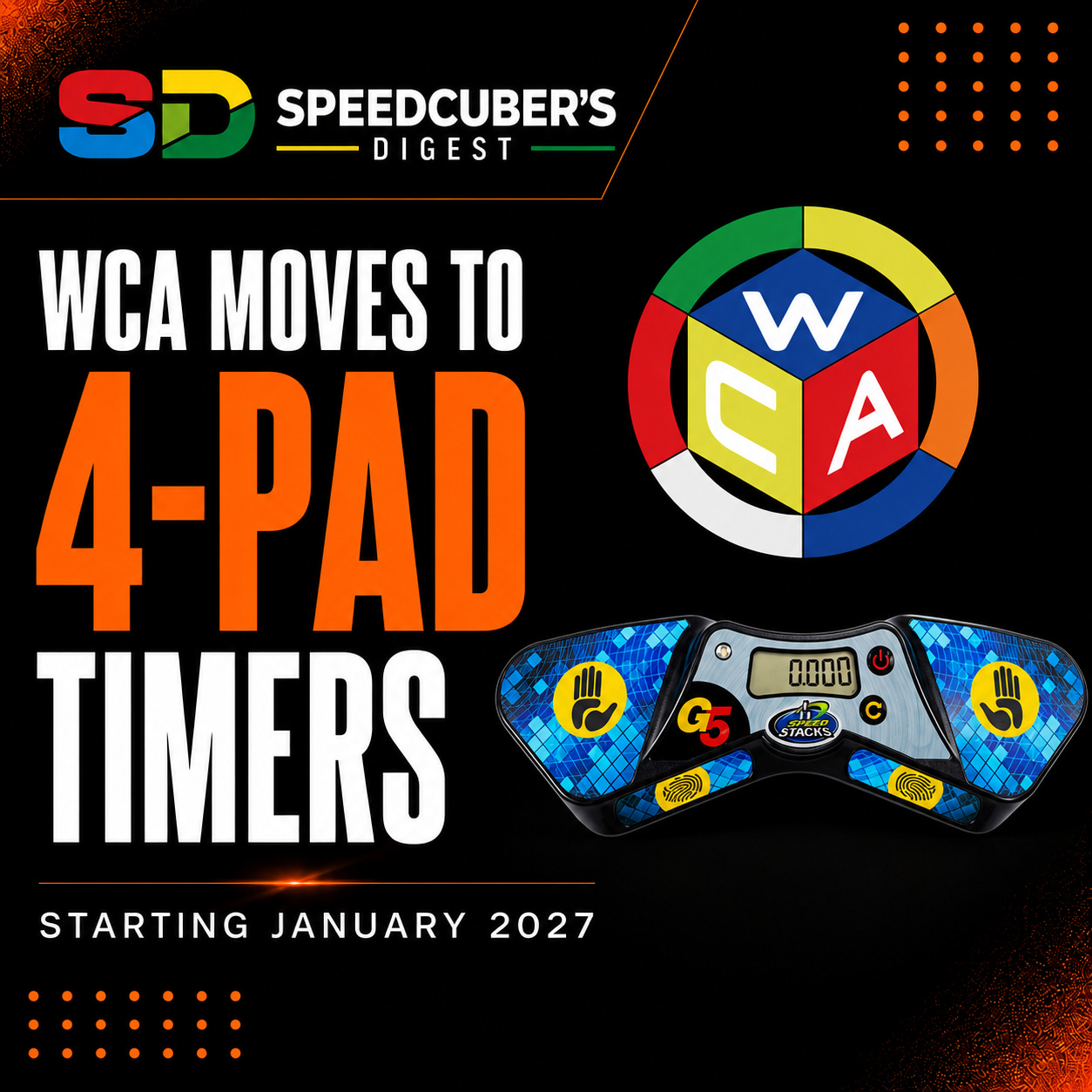
The World Cube Association (WCA) is moving to 4-pad timers.
Beginning January 2, 2027, every official WCA attempt that uses a speedsolving timer will be required to use a Speed Stacks G5 StackMat Pro Timer in 4-pad mode.
Read the full WCA announcement here.
The change brings the WCA closer to how some of speedcubing’s other major competitive formats already operate. The Premier Speedcubing League (PSL) allows organizers to use 4-pad mode, while Monkey League has also used 4-pad timing.
For the WCA, it is a major change from its current rules.
The existing WCA Approved Timer List requires G5 timers to be used in 2-pad mode and specifically says 4-pad mode is not permitted. G4 and G3 timers are also currently approved.
Starting next year, that will flip. G5 timers and 4-pad mode will become the standard.
Why 4-Pad?
The problem the WCA is trying to solve is not whether the timer can accurately measure time. It is making sure competitors actually start and stop it correctly.
With a traditional 2-pad timer, competitors only need to activate the two large hand sensors. That leaves more room for techniques such as “sliding,” where a competitor can begin moving toward the cube while part of their hands or wrists remain on the timer.
Similar issues can happen when stopping the timer.
These movements can happen so quickly that a judge may not be able to see a violation live. The WCA said some violations can only be reliably identified through frame-by-frame video review.
Four-pad mode adds the two smaller thumb sensors on the G5 timer, making it much harder to start or stop the timer improperly.
The WCA says this should nearly eliminate accidental timer violations and make intentionally gaining an advantage much harder.
A Debate That Reached the Top Level
Timer starts and stops have already become a major issue among elite speedcubers.
Xuanyi Geng has been one of the most visible competitors raising concerns about sliding and timer enforcement, particularly involving Yiheng Wang.
The issue became especially visible after Geng and Wang faced each other in WCA Head-to-Head competition earlier this year. Geng later posted criticism of Wang’s timer starts and stops, adding more attention to a problem that had already been debated throughout the community.
At the same time, other competitive formats had already started moving toward 4-pad timing.
The Premier Speedcubing League allows its events to use 4-pad hardware, while Monkey League has also used the system in competition.
That makes the WCA’s announcement feel less like speedcubing entering a completely new era and more like its largest governing body catching up with a change already being tested elsewhere.
According to its explainer, the WCA Regulations Committee began investigating 4-pad timing during 2025 and early 2026. Top competitors were asked for feedback, and the WCA says responses were strongly in favor of making the switch.
More groups were consulted during the spring before the WCA Board approved the change for the 2027 Regulations cycle.
What Happens to Existing Records?
Nothing.
The WCA will not reset World Records or create separate official record categories for 2-pad and 4-pad results.
Results set using 2-pad timers will remain official, and future 4-pad results will be ranked alongside them.
The WCA does acknowledge that 4-pad times are expected to be slightly slower.
For most competitors, the difference should be tiny. But at the highest level of sprint events, where hundredths of a second matter, the WCA acknowledges the difference could be significant.
Because of that, the WCA Rankings page will add a filter allowing competitors to view either all results or only 4-pad results for 2x2, Clock, Pyraminx and Skewb.
The WCA expects some existing records in those events to become harder to break at first, but says feedback from top specialists suggests they should eventually fall under 4-pad timing as well.
WCA Will Pay for the Transition
One of the biggest problems with requiring 4-pad timers worldwide is equipment.
Some regions still use older G3 and G4 StackMats, which do not have the four sensors needed for the new system.
The WCA says regions that need new equipment will receive G5 timers before the rule takes effect. The organization will cover the cost and handle the logistics.
Competitors will also have several months to adjust.
Draft Regulations covering exactly how competitors must start and stop the timer will be released for community feedback in September.
But the larger decision has already been made.
After years of requiring traditional 2-pad timing, the WCA is moving to 4-pad.
I think this is an overall welcome change!