


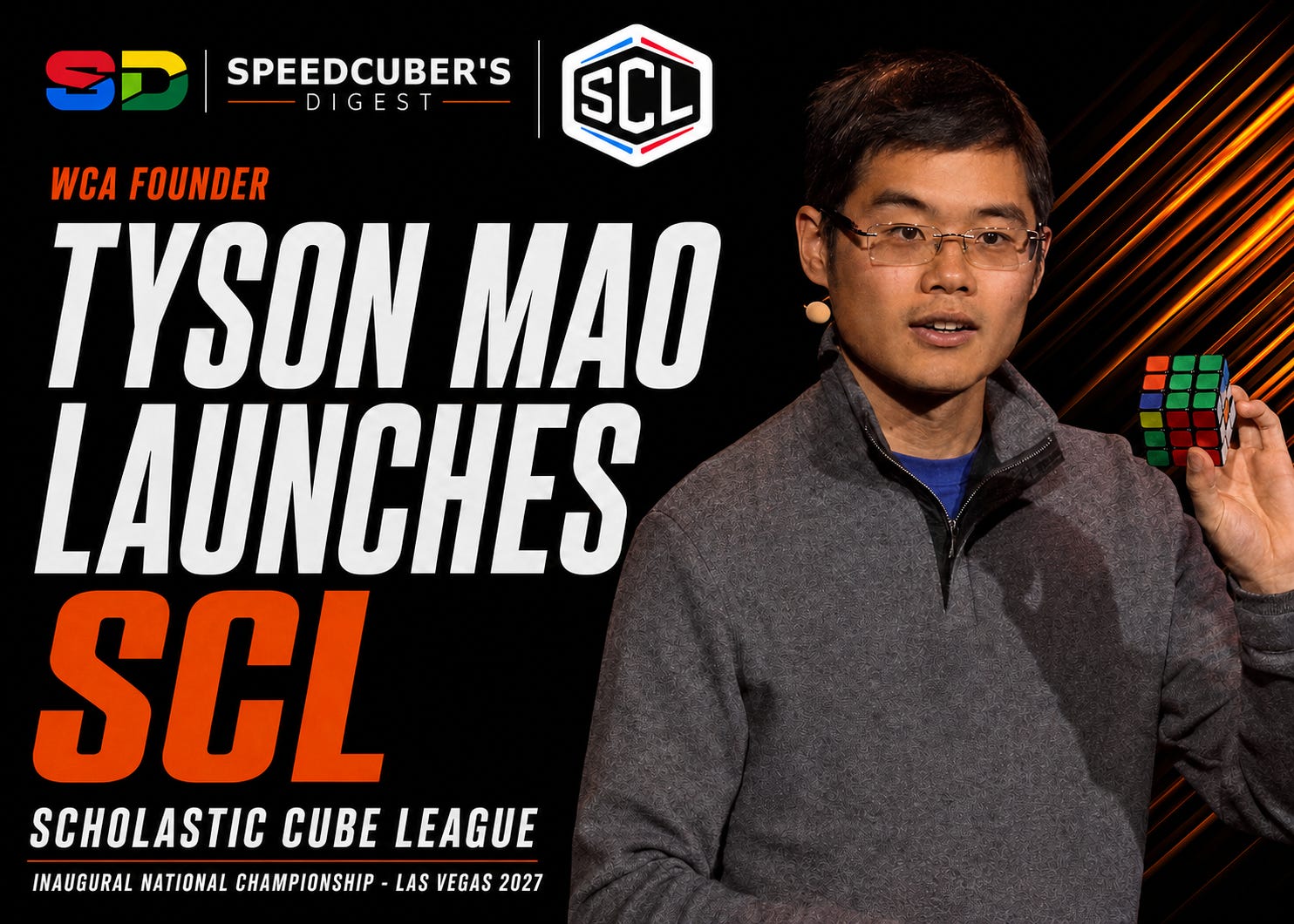
More than two decades after helping establish the World Cube Association, Tyson Mao is launching a new competitive organization built around school teams.
The Scholastic Cube League, or SCL, is a new national competition series designed specifically for elementary and middle school students. Teams of three to five students from the same school will practice throughout the school year before traveling to Las Vegas for the inaugural SCL Championships on May 15-16, 2027.
Mao is joined by longtime competition organizer Vincent Sheu, Premier Speedcubing League founder Michael Chai and a broader group of organizers and advisers from across the cubing community.
Rather than focusing primarily on individual results, SCL is built around a shared team score.
Students compete individually, in pairs and as a full team. Their placements earn Meet Points that combine to determine the overall school standings. The three schools with the highest totals will receive first-, second- and third-place awards.
In 3x3 Individual, each competitor solves five cubes consecutively, with their total time determining their placement. The placement ranks of each team’s three highest-ranked competitors are added together, with the lowest combined score ranking first in the event.
3x3 Pair BLD puts two teammates together, with one solving three cubes while blindfolded as the other verbally calls out instructions. The sighted teammate cannot touch the cubes or the solver during the attempt.
The team events increase the scale even further.
Teams will race to solve 25 puzzles at once in separate 2x2, 3x3 and Pyraminx events. A Mixed Puzzle event will combine 10 2x2s, 10 3x3s and five Pyraminxes into another 25-puzzle race.
Unlike WCA competitions, competitors will not use their own puzzles at official SCL events. Every student will compete on identical hardware provided by the league. For 2027, SCL will use the MoYu RS3 M V5 MagLev Ball-Core UV for 3x3, the QiYi M Pro Magnetic Ball-Core for 2x2 and the MoYu WeiLong Magnetic for Pyraminx. SpeedCubeShop is serving as SCL’s official puzzle partner.
The inaugural championship will take place at the Westgate Las Vegas Resort and Casino.
Registration is now open on a first-come, first-served basis. SCL is accepting its first 100 teams for the inaugural championship, with additional entries dependent on capacity. Registration costs $175 per student through December 15, 2026, and $250 per student after that.
Seed rounds will take place Saturday and Sunday morning, with the top eight teams advancing to the finals Sunday afternoon.
The full schedule is available on the championship page.
SCL has also introduced weekly online Sunday Contests, giving students a way to compete individually or with a team throughout the school year. Each contest begins at noon Pacific, and participants need a verified SCL account to enter.
Schools are also encouraged to organize local meets throughout the year. Those events are run independently by schools rather than officiated by SCL, but the league plans to maintain listings for teams looking to compete locally before the championship.
A Different Model for Competitive Cubing
Mao entered the competitive cubing community in 2003 and helped organize the first U.S. competitions at Caltech the following year. In August 2004, Mao and Ron van Bruchem founded the World Cube Association, establishing the organization that would go on to standardize competition and maintain official results around the world.
“When I started the WCA back in 2004, your stereotypical cuber was a college student or a young adult,” Mao told Speedcuber’s Digest. “When I look at the landscape of competitive cubing today, your stereotypical cuber is an elementary school student.”
Mao said the idea behind a scholastic cubing program has been with him for years.
“My earliest ideas around a scholastic program for cubing date back to 2009, so I have believed for a long time that this project would serve the community well,” he said. “Twenty-two years after founding the WCA, I am now the parent of a 10-year-old son and a 5-year-old daughter, and I see the SCL as a way for them and students around the country to have fun and build a project with their friends at school.”
He added that the school-based model is also intended to keep the competition rooted in local communities rather than becoming a hunt for all-star rosters.
“It’s not about going out into the world and finding the best cubers and assembling a team of five that will dominate the competition,” Mao said. “Instead, it’s about leadership and your ability to grow a team of five from your own community.”
The league is independent from the WCA, but Mao does not see the two as competing visions.
“There’s absolutely still a need for an organization where cubers can go and get official results,” he said. “The WCA is perfect for that.”
Mao added that he hopes SCL participants also compete in WCA events.
For Mao, the biggest difference is that SCL is not built around chasing official results year-round. Instead, it is built around a school-year experience centered on teamwork, leadership and season-long participation, culminating in a national championship.
“Twenty years from now, I hope that the SCL experience will be a core memory for these children.”
More than two decades after helping create the organization that shaped modern competitive speedcubing, Tyson Mao is once again introducing a new way for cubers to compete.
This time, the goal is bigger than finding the fastest individual solver.
It is to build the best team.
