


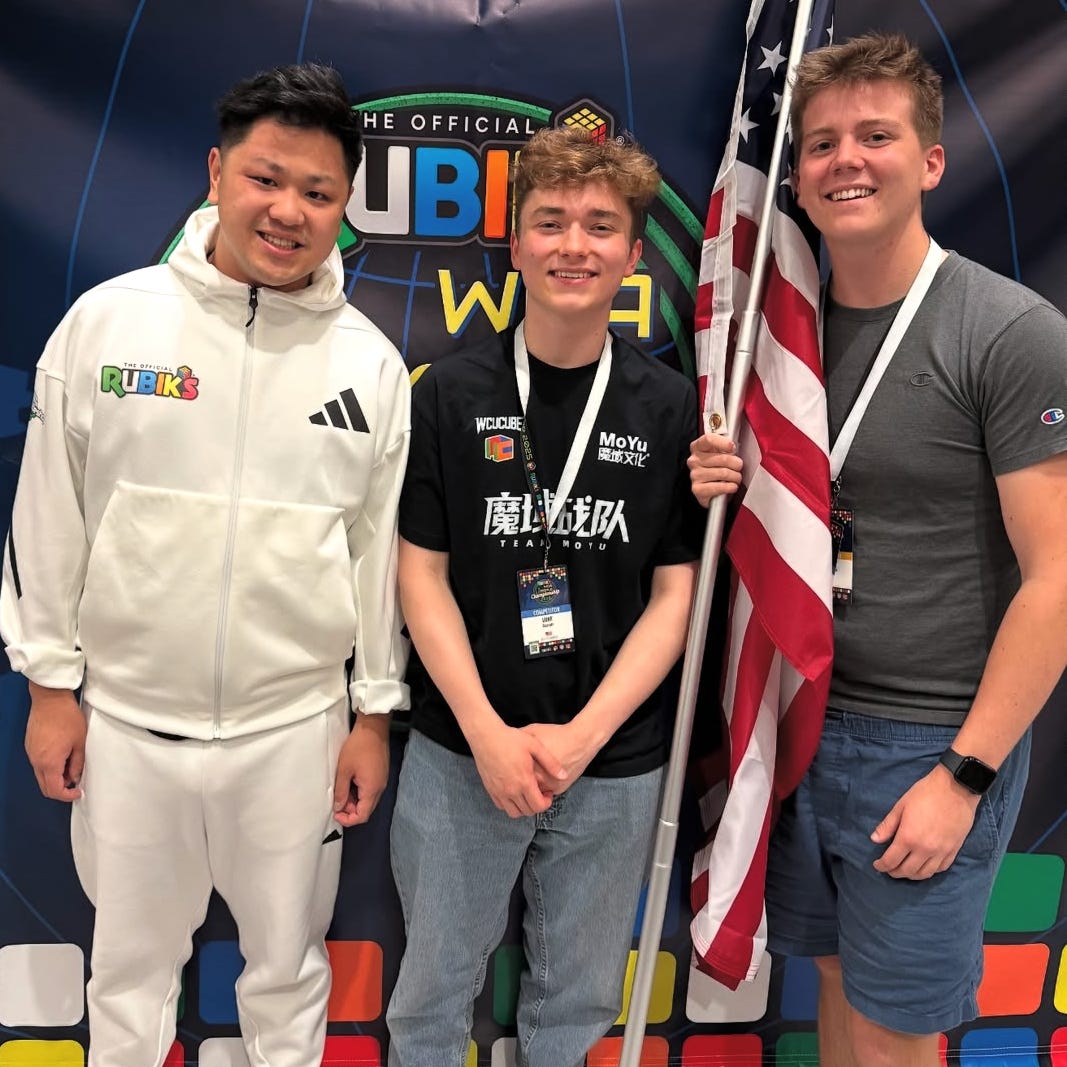
NAC is still well over a month away, so yes, this is way too early.
Perfect. Let’s do it anyway.
The 2026 Rubik’s WCA North American Championship already has the shape of a great 3x3 event. The top of the field is loaded, the final will only have 16 spots, and the difference between “obvious finalist” and “just missed” could come down to one shaky average.
For this preview, we used Nicholas McKee’s prediction model with the past year of results and a 180-day half-life, meaning recent results carry more weight. The model estimates expected rank, podium chance, and win chance for the registered field.
It is not a crystal ball. It does not know who slept badly, who changed cubes, who warmed up well, or who has spent the last month grinding solves in silence.
But it gives us something different than sorting the WCA rankings page by average.
What the Model Sees
At the top, the model points to a clear title race.
Matty Hiroto Inaba has the highest win chance at 39.26%, while Max Park is second at 30.81%. Luke Garrett sits third at 13.14%, followed by a noticeable drop to Luke Griesser at 3.44% and Dylan Miller at 3.43%.
That creates three early tiers:
The Favorites: Matty Inaba and Max Park
The Clear Third Option: Luke Garrett
The Dangerous Group: Luke Griesser, Dylan Miller, Caleb Chen, Neo Cuares, Alexey Tsvetkov, and Kyle Santucci
The model also gives Max a slightly better expected rank, 2.60, compared to Matty’s 2.74, and a better podium chance, 77.55% compared to Matty’s 75.61%.
So even the model does not give us a simple answer. It likes Matty slightly more to win, but trusts Max slightly more to finish high.
That feels about right.
Why WCA Rankings Only Tell Part of the Story
The WCA rankings page is the easiest place to start. If you sort the registered NAC field by 3x3 average, the top names look familiar: Matty, Max, Luke Garrett, Brian Johnson, Dylan Miller, Caleb Chen, Kyle Santucci, and Luke Griesser.
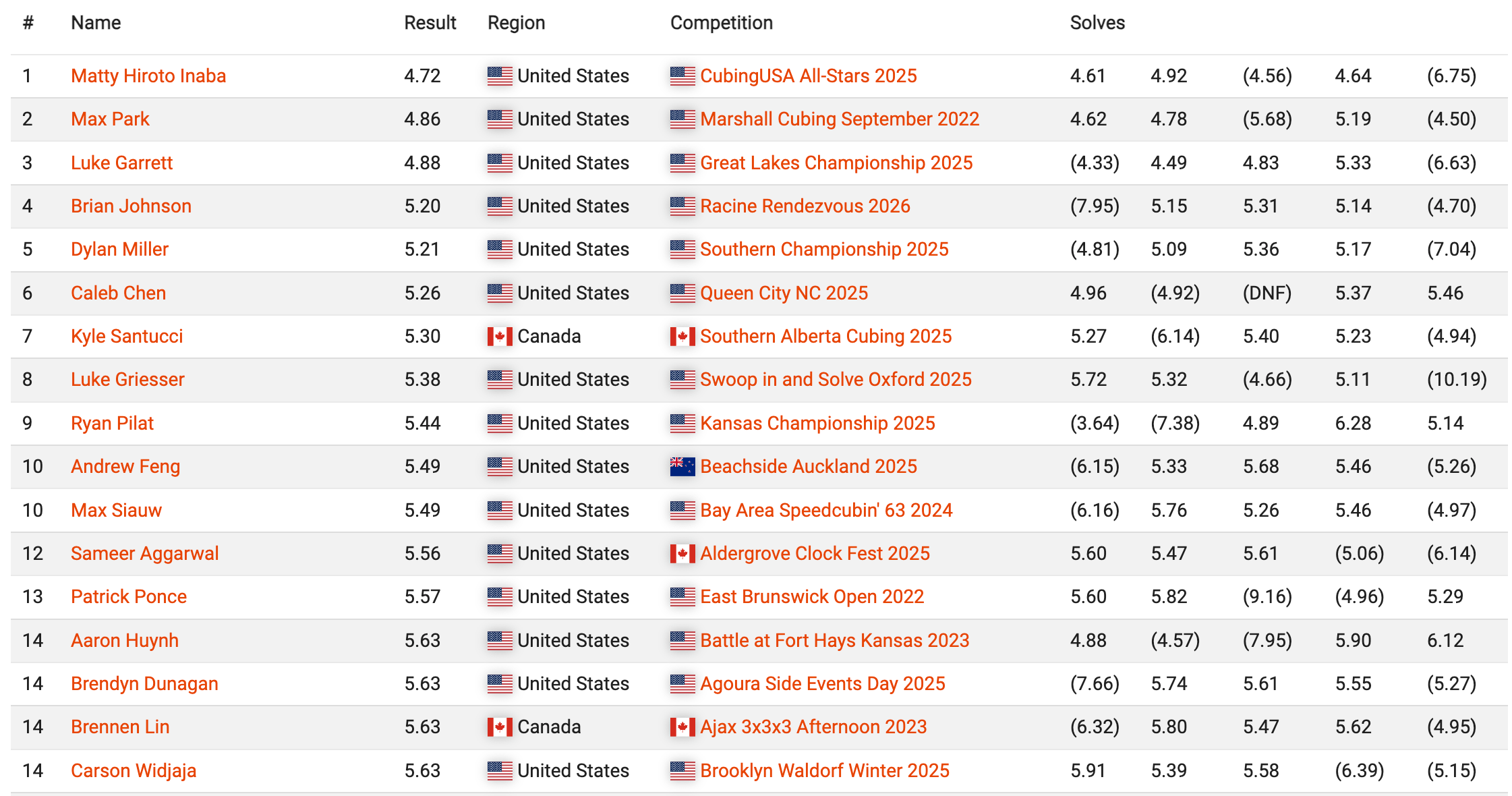
That tells us who has the best personal bests. It does not necessarily tell us who is most likely to survive multiple rounds and make a 16-person final.
A personal best average is one great round. NAC is about doing it again, under pressure, against a deep field, with everyone else trying to do the same thing.
That is where the differences get interesting.
Brian Johnson is fourth by WCA average among the registered field with a 5.20, but the model gives him an expected rank of 13.78.
Neo Cuares goes the other direction. He is 16th by WCA average at 5.70, but the model has him seventh by expected rank with a 12.23% podium chance.
The rankings page shows peak results. The model is trying to predict the weekend.
Is This Really Matty vs. Max?
Matty and Max are clearly separated from the rest of the field. Together, they account for just over 70% of the model’s win probability. Everyone else combined is chasing the remaining 30%.
Matty’s case is obvious. He has the highest win chance in the model and owns the North American 3x3 average record with a 4.72 from Rubik’s x TheCubicle CubingUSA All-Stars 2025.
But that same All-Stars event also adds a wrinkle. Matty broke the record in the Semifinals, then lost to Max in the final. (Matty’s NAR is below)
That is what makes this matchup interesting.
Matty has the loudest recent peak. Max has the most proven final-round résumé in the sport. The model somehow captures that tension: Matty has the better win odds, Max has the better expected rank and podium chance.
Luke Garrett, the Clear Third Option
Luke Garrett might be the hardest person in the field to categorize.
The model gives him a 13.14% chance to win and a 43.14% chance to podium. That is nowhere near Matty or Max, but it is also miles ahead of everyone behind him.
He is not quite a favorite. He is not just part of the pack either.
He is the clear third option.
Garrett has carried the “Fluke Garrett” nickname for years, and part of what makes it stick is that he always seems to find himself near some kind of strange, memorable moment. At Worlds 2025, he cut his finger open on the way onto the stage after catching it on the entryway backdrop. It was bizarre, unlucky, and somehow exactly the kind of story people associate with him.
But the nickname can also undersell how good he actually is.
Garrett is not sitting third in the model because of luck. He has the speed, the practice, and the results to put himself in a real position. The question is whether this is the weekend where everything lines up cleanly.
Who Actually Feels Safe for Finals?
Using expected rank, the model’s projected top 16 currently looks like this:
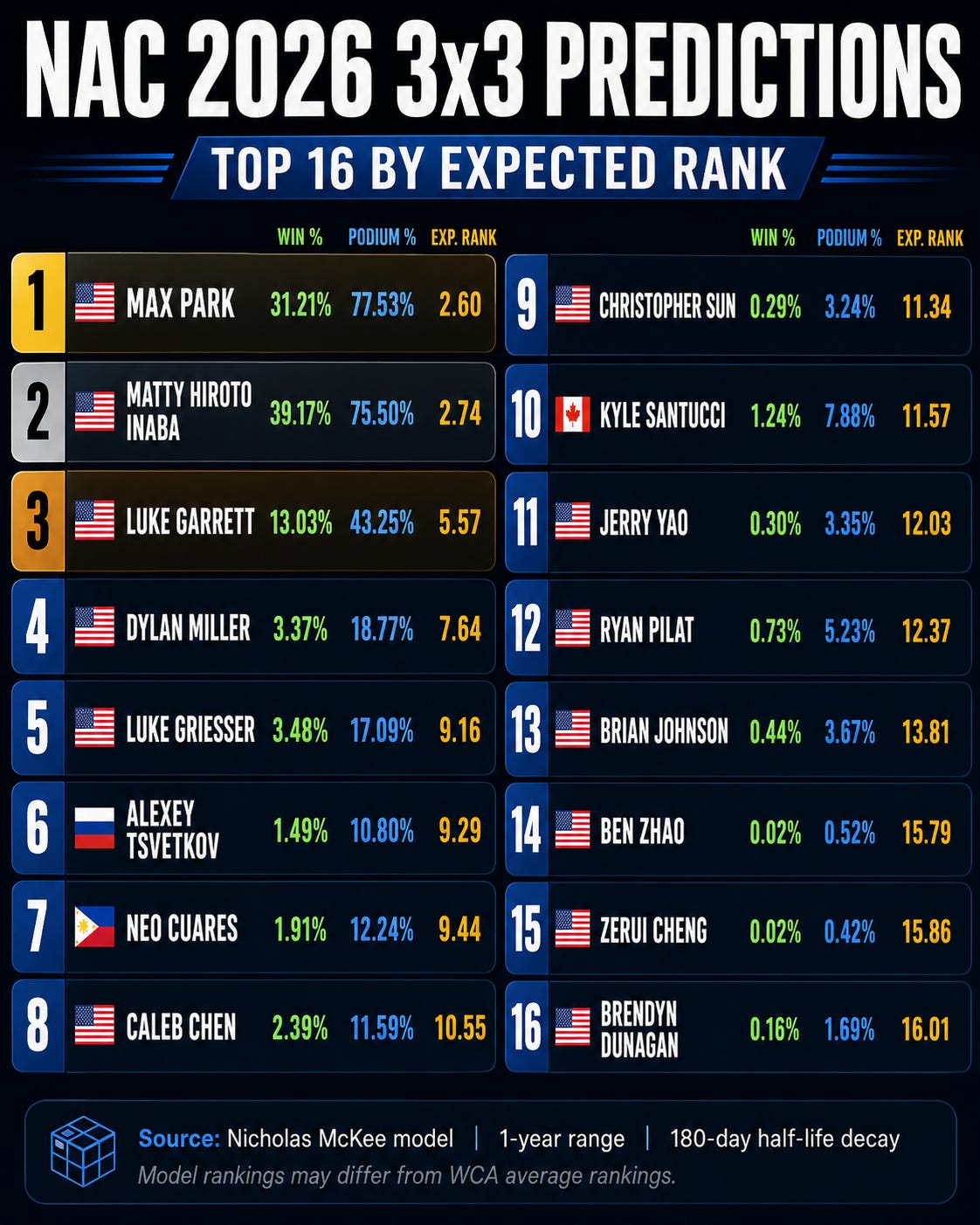
The top three feel safe. The next few feel very likely. After that, things get uncomfortable quickly.
Dylan Miller, Luke Griesser, Alexey Tsvetkov, Neo Cuares, and Caleb Chen all project comfortably into finals, but not so comfortably that they can afford a messy round.
By the time you get to the 10-16 range, the margins start feeling thin. Kyle Santucci, Jerry Yao, Ryan Pilat, Brian Johnson, Ben Zhao, Zerui Cheng, and Brendyn Dunagan all sit in the projected final, but the bubble is close enough that a couple of bad solves in semis could change the entire picture.
Christopher Sun is worth flagging here, too. The model has him ninth by expected rank, but he finished second in last year’s 3x3 final, ahead of Matty Hiroto Inaba.
The Bubble Is the Fun Part
Brendyn Dunagan currently sits 16th by expected rank. Right behind him are names like Carson Widjaja, Siddharth Reddy, Jeremy Bulambot, Max Siauw, Dominic Redisi, and Zeke Mackay.
That is where the final could get chaotic.
The model may have a clean cutoff, but competitions rarely do. A single counting 7, a missed easy solution, or one competitor landing a career round at the right time could move several people across the line.
This is also where the event still being more than a month away matters. NAC has a 1,200 competitor limit, and roughly 900 competitors are currently registered. More people could still sign up, and some could drop before the competition.
That said, the top names in the U.S. and North America by 3x3 average appear to be registered already. So while the field can still change, the title picture probably will not be completely rewritten by late additions.
The Criminally Underrated Group
This is where I am most willing to argue with the model.
Dylan Miller and Luke Griesser are not in the same statistical tier as Matty, Max, or Garrett. The model gives Miller a 3.43% win chance and Griesser a 3.44% win chance. Their podium chances are also close, with Miller at 18.89% and Griesser at 17.19%.
On paper, they are behind the big three.
But this is where raw numbers do not tell the whole story.
Dylan has been in major finals repeatedly, finished eighth at Worlds, and has won multiple PSL events. Griesser has also shown he can win in high-pressure settings, including a PSL win over Dylan this year. (Video below) Both are qualified to compete at the PSL Championship in Vegas after NAC.
These are not just fast solvers with good averages. These are competitors with real finals experience and repeated reps in high-pressure formats.
That matters.
The model is probably right that they are not favorites. But if the question is “who can sit in a final, take a punch, and still find a way onto the podium,” Dylan and Griesser feel more dangerous than 3.4% win odds suggest.
They may need a great day to win, but calling them long shots feels too dismissive. They are more like the two names nobody should want sitting next to them in a final if things start getting weird.
The Way-Too-Early Read
Matty and Max are the favorites. Luke Garrett is the clear third contender with a real path to the title. Dylan Miller and Luke Griesser are the two names that feel more dangerous than their odds suggest, while Christopher Sun is the reminder that last year’s final already gave us a reason not to trust the model too blindly.
After that, the real battle might just be making the final.
Sixteen spots sounds like a lot until you start counting names. Someone fast is going to miss.
The model gives us a starting point. The real story starts when the first round does.