


Members can watch the video interview with Matty in our Exclusive section here.
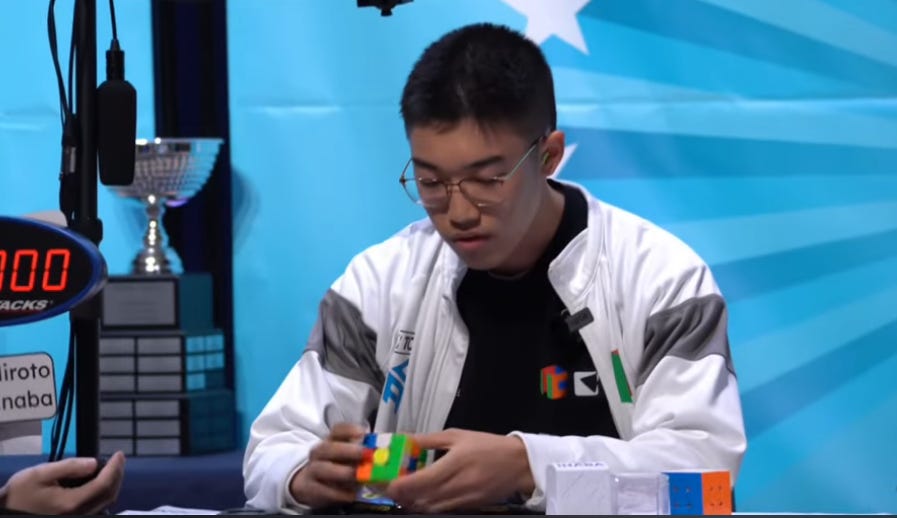
From the earliest days of competitive cubing in the early 1980s to the present, there have been innumerable shifts in technique, cube, and, most importantly, dominance. It seems like most of the world has been in a transitional period when it comes to that last metric, with a new generation of cubers taking times down to previously inconceivable levels. But that next generation seems to be stagnant in one of the biggest cubing nations in the world: the United States. Of the top 50 solvers ranked based on average in the US, only 12 have a WCA ID from 2021 onward. In a competitive world that is quickly being dominated by an influx of younger cubers from Europe and China, the US is arguably in a declining state of competitive relevance when it comes to its next generation. However, one cuber is looking to change this trend by personally coaching a trio of up-and-coming young cubers into the US’s next superstars. That competitor is the United States’ number-one-ranked cuber: Matty Hiroto Inaba.
“I can kind of just sense the US stagnating. All of the good cubers are old: I’m 19, Max [Park] is over 20, Luke [Garrett] is also a similar age… We can’t have the top three in our continent being that old; it’s just not going to fly anymore. I just want to try my best to train these young kids and get the next generation some momentum. If you look at all the other continents, there’s young kids… Teodor [Zajder] just took ER from Tymon [Kolasiński]. It’s happening elsewhere, but it still hasn’t gained momentum in the US.”
Inaba’s solution, first announced in March, is a program called the Elite Cubing Initiative, in which he plans to mentor a group of up-and-coming US cubers to become the United States’ response to other regions having new generations of cubers taking over.
“The people that are part of the team [are] Shota Fukuoka, Kavin Prince, and Zerui Cheng. Those are my three that I have. They’re fast enough to where they have all the basics down… they’re good enough to create their own style. So what I need to do is just make sure like… you know, good finger tricks, good habits, no bad habits, and then just give them the materials so they can create their own styles… Also, I just wanted to give them a place where they could compete with kids at a similar age and similar skill level as them. In my personal experience, going to the PNW a lot and seeing Asher [Kim-Mageriek], Max [Siauw], Sameer [Aggarwal]... being able to compete with them and get better together really helped me to get good at 3x3. I just wanted to kickstart them and give them that platform to do that.”
All three of Inaba’s mentees rank within the top 100 based on average in the United States, with Cheng ranking highest at 22nd in the country and 98th in the world. According to Inaba, given that their fundamentals are already developed, he feels that a competitive environment will be the most beneficial for their future cubing success.
“I want to experiment with doing a lot of TPS training, because TPS is really important in today’s solving environment. But also, just having them compete against each other, I feel, is going to be the most important thing for them. That’s how you improve… Coming from Hawaii, it’s hard to improve when there’s not people who you’re competing with constantly… Giving them the opportunity to compare times and we all work on the same scramble, and we all exchange ideas… that’s gonna be the valuable part, I think.”
“There is no reason the US should not be fostering the growth of kids as young as Teodor and Xuanyi. Cubing is one of those things where young kids can excel. There’s literally no reason that it shouldn’t be happening in the US. It’s not like, ‘oh, I feel bad for the US,’ or, ‘oh, we have a problem,’ it’s just that there’s an opportunity here.”
Inaba also said that while he’s happy to help train these cubers for the purposes of helping build the next generation of US speedcubing talent, he also hopes that his mentorship will serve as a way to give back to the community that he’s been a part of for a long time.
“I also just wanted to give back to the community. I haven’t really had a platform like this where I can fully give back… They’re not paying me anything, this is just for free… I just wanted to help the community out, and I have faith that these kids will represent us well.”