

Editor’s Note: This is the third installment of a four-part series by Nishkal Pandya. Members can also read the complete article as one piece, along with unreleased notes from the author, in our exclusive section.
The views expressed are the author’s own. This article presents the author’s personal training philosophy and an intentionally extreme thought experiment. It is not professional child-development advice. Any training involving a young child should remain voluntary, enjoyable, age-appropriate, and responsive to the child’s health and well-being. If the child no longer wants to participate, the training should stop.
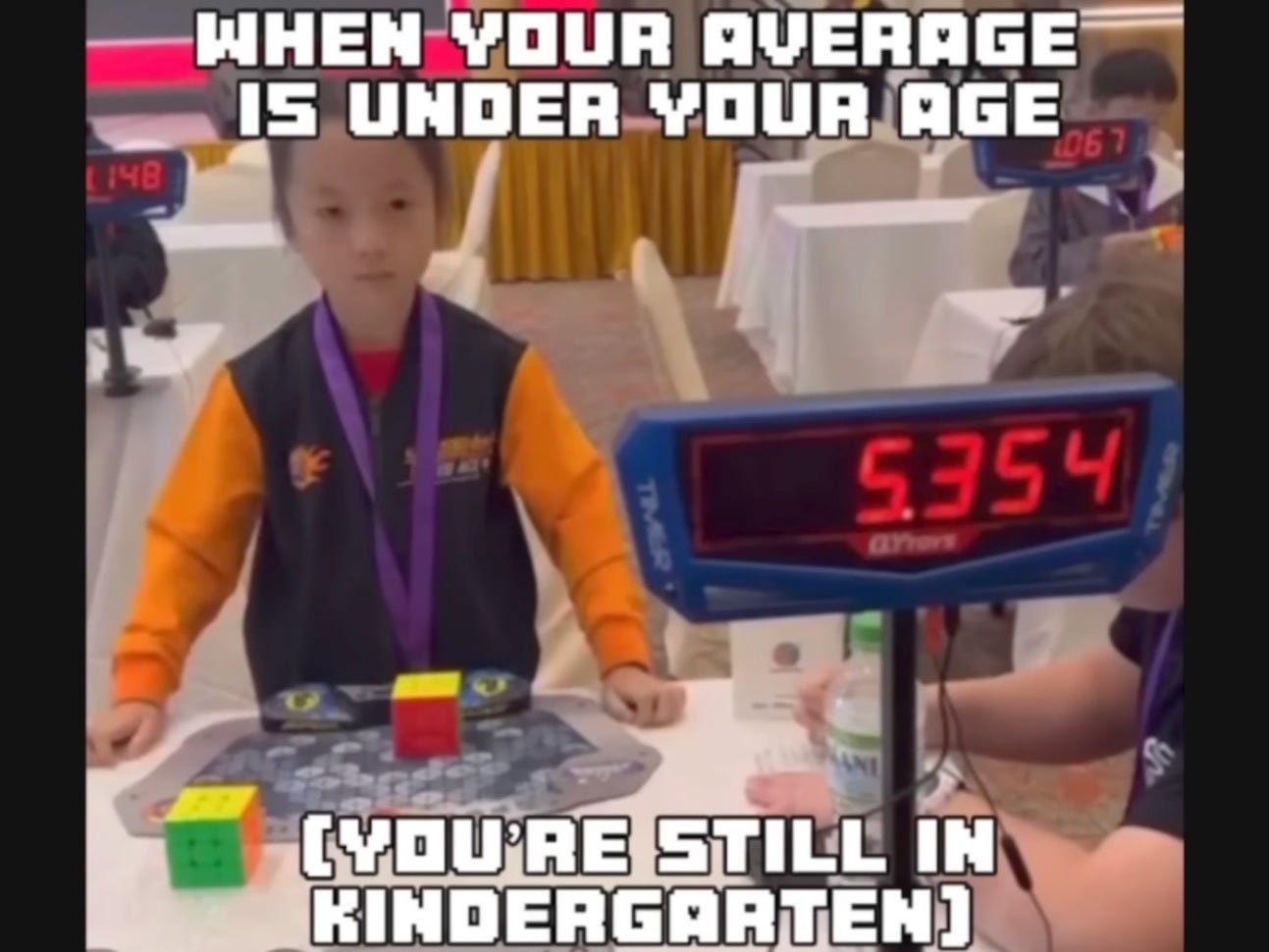
Last Layer Last
More Algs ≠ Faster Times
If you ask most cubers what they will learn next to improve, the answer is often “more algorithms”. It’s understandable why. Algorithms are numerical, graspable, trainable, and are something you can tell people you know. Algs are not the reason someone is slow at a certain point. They are made to optimize a strong solve. This is why someone who averages 12 does not benefit from learning full ZBLL, but Tymon did. His F2L and foundations were already so good that the new algs helped him get faster in a way that was worth his time. If the turning is bad, the lookahead is lacking, or your solutions are inefficient, saving 5 moves on last layer will not help.
Basically, algorithms are the final optimization. Never sacrifice lookahead/prediction, efficiency, mechanics, or fingertricks for more algs. Algorithms do not create champions. They polish the champion-level fundamentals.
CFOP: The Base
I will make sure the base 78 algs are perfect before going into larger algsets. Starting with 2 look OLL and 2 look PLL, recognition should be sub0.7 for both cases, and exec should be sub1. After that, I would expand that to full OLL and full PLL and use algorithm trainers to train recognition and exec to the previous requirements.
After this, adding on the concept of predicting OLL/PLL so transitions are pauseless like Yiheng’s would help teach the recognition scheme to help them learn larger algsets like ZB or VLS or even 1LLL. Once this is mastered, the child could be around sub7 or even sub6.5 (remember that they mastered cross and F2L already).
ZBLL: The New Meta
Back in the day, OLL and PLL were normal, and there was no reason to innovate or optimize more. You could get a good solve in 1 of 2 ways: a high-TPS solution but medium movecount, or medium-TPS and lower movecount. Now, you need a low movecount and high TPS.
A world-class solver doesn’t become fast because they know ZB. They learned ZB because they already were fast and ZB would make them faster. If you want to learn full ZB, learn full CFOP first. ZB is a method designed to be more efficient than CFOP. You first do ZBLS, which solves the last pair in a way that makes a cross on top, and then ZBLL, which solves the rest of the cube. This is around 800 algorithms, which take time to recognize but are more efficient. This is why a lot of top solvers have a pause during last layer. They have to recognize a case by identifying corner patterns and edge patterns.
If a child is trained properly with ZBLL, they can recognize the cases faster than most people recognize OLL and PLL. Xuanyi Geng is the best example of this. He regularly recognizes ZBLL in less than 0.4 seconds. His success is why all the new Chinese solvers are using full ZB. They were raised to be world-class, and they trained to perform at that level.
In the past, ZBLL was considered impossible and impractical to use in solves. Now, the bar is raised, and another algset is considered impossible and impractical to use.
On 1LLL
If you ask any top solver or coach if a child can learn 1LLL, you will get mixed answers. However, if you ask them if they should, the answer will be no.
They’re probably right. Making a child learn 4,000 algs, plus 2-sided recognition, is very difficult due to a low attention span, the sheer volume of cases, and how hard recognition is. Also, the amount of time spent learning 1LLL can be used for inspection, lookahead, turning, solutions, or more. 1LLL is theoretically better, but not practically better.
But people said the same thing about ZB. The goal is not to train a 3-year-old to be world-class in a year. It’s to train them to be #1 in 3 years. Since they already can predict 3 or more pairs, their turning is solid, and their solutions are optimized and ergonomic, they can set aside time to learn full 1LLL. The recognition scheme is similar to ZBLL, just more cases to choose from. It is possible to do it. Last Layer King, otherwise known as Fletcher Berry, knows around 1,000 1LLL algs. He has a 10.39 average. There is someone better, who has better recognition. Introducing Eduardo Silva Damasceno, also known as EDMARTER. He has a 9.93 official average and has posted a 7.13 average with recognition speeds of under one second. He has also learned algorithms from more obscure algsets like TCOLL, EELL, TTLL, L5C+L5E, and even 1LLL with a flipped edge case as the 4th pair. This shows that it is possible and even potentially viable to learn 1LLL and use it in competition with good results.
If you are training a child to be world-class, I would still recommend ZB due to the resources and progress in developing the method, which cannot be said for 1LLL. I am confident that 1LLL will be the future of world-class solving methods, and it doesn’t hurt to try to usher in the future of speedcubing.
Recognition Over Execution
When people think and train algorithms, they focus on execution speed and fingertricks. However, execution is only half of an algorithm. Before a solver can execute, they have to recognize. If recognition takes too long, it doesn’t matter how fast you can do the alg.
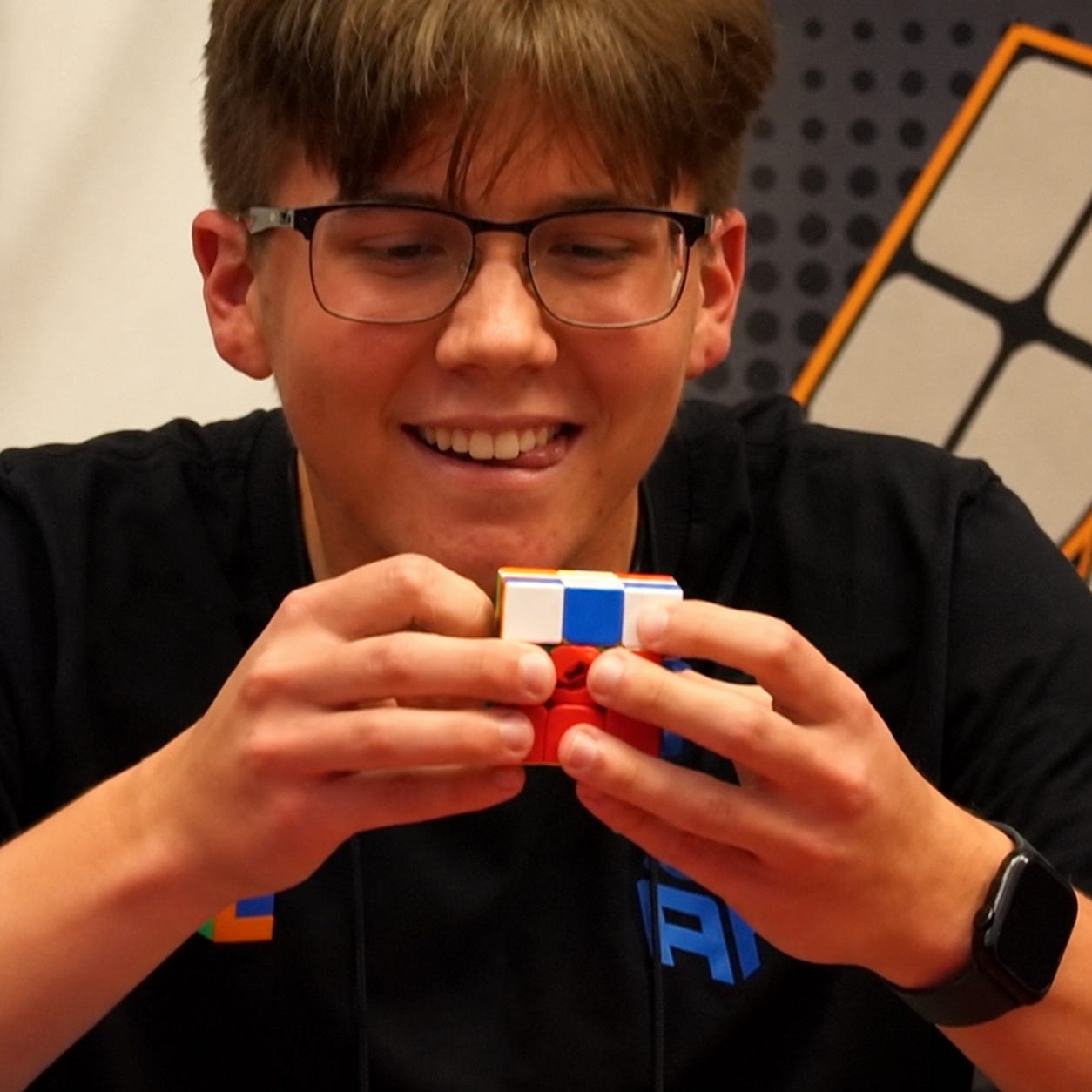
There are a variety of ways to recognize cases, and I will talk about all of them. The simplest way is just identifying blocks and figuring it out from there intuitively. The Baum-Harris (BH) system is a 3-part system: Recognize the OCLL (orient corners), identify the corner pattern, and then a 3-piece pattern in the front (UFR, UF, UR) to determine EP. The Tran (Tv2) method uses COLL, and then tracks 2 specific edges and determines if they are equal, adjacent, or opposite to another sticker. The Twisty-PLL method is just exactly what it sounds like: imagining the PLL if the corners were twisted.
To train recognition for ZBLL until it is Xuanyi-level, learn Baum-Harris first. Choose a recognition angle, and identify blocks like bars, opposites, or matching. This combines the intuitive with BH, making it easier to put in your muscle memory. Training 3-sided and eventually 2-sided, you should use a smart cube. Connect your Bluetooth cube to cstimer.net, select CFOP, go to ZBLL. In settings, change Cube Mode to Training or Continuous Training and Virtual Cube Display to qCube. You will see the front, left/right slots, and the top. For 2-sided, change qCube to q2look, which shows 2 sides and the top face. Tymon made this video explaining how to do this.
Since I mentioned 1LLL, I will try to talk about the recognition schemes. The BH method can be as follows: Recognize the OLL case from the fixed angle, mentally flip the bad edges, and perform ZBLL BH. For Tran, it’s a lot simpler. You recognize the OLLCP, then the edge permutation (Ua, Ub, H, Z, or their parity variants). This eliminates the idea of mentally flipping edges and, combined with an intuitive approach for identifying blocks and patterns, is the fastest and best way to learn 1LLL recog. From there, follow the BlueTooth cube training for every set until it is sub-0.5 recog. Furthermore, some cases look identical from 2 sides, so the most work has to be put into differentiating the twins.
After I wrote this, I talked to Twan Dullemond, and doing Baum-Harris + flipped edges is better in the long run for 2-sided 1LLL recog. Tran wouldn’t work because the JOLL (EP prediction) recog could be out of sight.
Whatever you choose, recognition must be faster than 0.5, and then the execution should be instant from muscle memory. At the end of the day, your last layer is only as fast as your recognition time.