

Editor’s Note: This is the second installment of a four-part series by Nishkal Pandya. Members can also read the complete article as one piece, along with unreleased notes from the author, in our exclusive section.
The views expressed are the author’s own. This article presents the author’s personal training philosophy and an intentionally extreme thought experiment. It is not professional child-development advice. Any training involving a young child should remain voluntary, enjoyable, age-appropriate, and responsive to the child’s health and well-being. If the child no longer wants to participate, the training should stop.
Building Foundations
After the environment is optimal for them to be fast, I would start by teaching them the beginner method. I would use their solve time as a benchmark here. A lot of people think getting faster is turning faster and doing solves. However, that reinforces bad habits. At this stage, 2 things matter a lot: finger tricks and efficiency. After these ideas are set, then we can move on to large algsets, prediction, and turn speed. The top Chinese cubers have analyzed Matty Hiroto Inaba’s solves, and the next generation will use a combination of Matty’s, Yiheng’s, Tymon’s, and Xuanyi’s solutions to analyze and incorporate into their solves.
Fingertricks
If you watch a beginner solve, they will constantly regrip, always rotate, and sometimes have weird wrist turns. During the solve, it feels fast but looks slow, adding seconds. Proper fingertricks are necessary to be fast.
The first thing I would teach is to have a stable home grip. This is the best grip that can turn every face except the B face with no regrips. However, the B face is rarely used, so this is ok. I would also reduce as many unnecessary regrips as possible. It only costs you a tiny bit of time, but it compounds over an average in competition.
After fixing regrips, I would make sure every fingertrick is anatomically optimal. Based on Brandon True’s video on the biologically right way to turn a cube, flexion (pulling a finger inward) is stronger and more controlled than extension (pulling it away). Instead of relying on wrist rotations, turning should be made of small finger movements that reduce travel distance. This is also why a lot of the young solvers use loose, “exploding cubes.” It helps their fingers, which lack a lot of strength, to easily make turns and do it quickly. Some cases of this include middle-finger U moves and pinch F. Middle flicks are becoming popular among the Chinese cubers due to the ability to prevent a regrip (Ex. R U R’ U or R U’ R u’). A longer algorithm can sometimes be chosen because the fingertricks are easier to do. With good fingertricks, turn speed can be built through PLL time attacks, burst turning drills, downsolves, and drilling algs.
Efficiency
When the kid has solid fingertricks, I would teach them beginner F2L and then introduce them to multiple more efficient solutions from all 4 angles. After that, I would introduce the idea of how all those moves affect pieces on the cube. The goal is to make the child learn the cube like a second language, and that comes with deeply knowing how moves influence the pieces.
I would encourage them to choose their preferred solutions due to move count, ergonomics, and how it affects pieces on the cube.
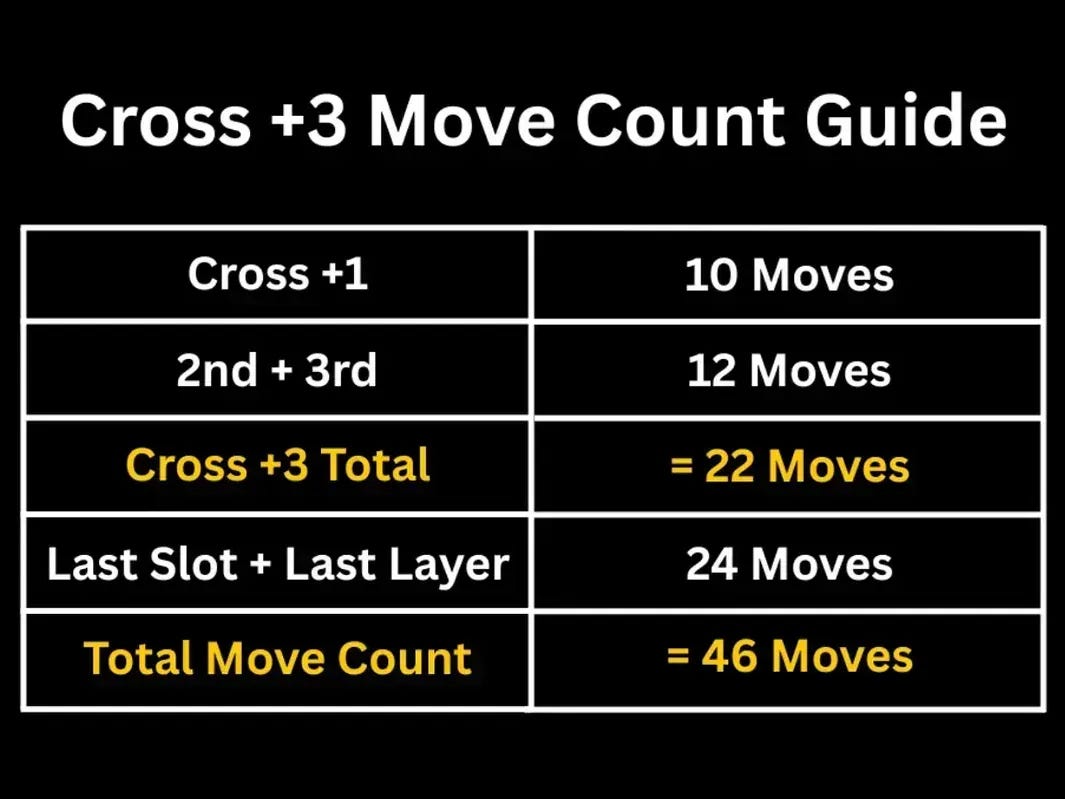
From there, I would introduce the concept of setting up free pairs. For this, we would analyze Yiheng’s solves, since he is really good at this. He reduces move count while also being able to turn fast. This leads into the concept of multislotting, which is inserting multiple F2L pairs. This goes in with lookahead, so I will talk about it more in the lookahead section. After the base 42 and the advanced cases, I would introduce pseudoslotting around the same time as learning how to set up free pairs. For this, they would need to understand the concept of edge orientation, which also helps the child understand when and when not to rotate.
Reducing rotations makes sure that turning is constant and not on a pause. Furthermore, I would make them learn how to rotate properly. The proper way to rotate for y rotations is to move the right thumb first, then the left thumb. For y’, move the left thumb first, then the right. Xuanyi Geng made this mistake, but it has been reduced after Dylan Miller pointed it out. This saves around 0.1-0.2, which may not seem like much, but at a top level, every tiny 1% improvement compounds.
Lookahead/Prediction
By this time, the child can solve the F2L efficiently. At this point, F2L should be taking around 10 seconds, give or take. Now it is time to introduce lookahead. Without lookahead, solvers focus on one F2L pair at a time. To quote Tymon, “I solve cross. I sleep. Solve a pair. Sleep. Solve a pair. Sleep. Do that a few more times, and then you get to PLL.” This basically describes a lot of cubers’ solves. Top solvers either look ahead to the next pair while solving the current pair or plan that pair in inspection so they can look ahead to a different pair. Either way, lookahead is important and helps reduce pauses. After they get good enough lookahead, the concept of prediction can be trained.
This can be done through untimed solves, where the goal is not to pause during the entire solve. When that is achieved, I would push for them to up their turn speed a little bit and help build up look-ahead. I would also teach them the lookahead flowchart that Dylan Miller made, which is to scan the top layer, then the front slots. If there are not 2 pieces that go together, one of them will be in the back slot. For multislots, I would have the child set up basic triggers like R U R’, R U’ R’, R U2 R’, sledge, hedge, and more. I would ask them, “Solving this case does what to the other pieces on the cube?” I would then extend this logic to all F2L solutions, which would give them the ability to understand what certain solutions do to other pieces on the cube and how a different solution could force a free pair.
The end goal of all of this is for them to understand the Rubik’s Cube like a second language and understand how certain moves affect all the pieces on the cube. After this, I would copy Xuanyi’s training to plan 3 or more pairs in inspection: every day, use unlimited inspection time to plan as deep into the solve as possible. The brain will build up the capacity to plan a full F2L but only with simple, efficient, and not fingertrick-friendly solutions. From there, I recommend they incorporate advanced concepts like multislotting, pseudoslotting, or more complex XCrosses. By the time they compete for the first time, they should be able to predict Cross +1 at a minimum. When you predict a large part of your solution, you can turn much faster than if you were using lookahead.