

Editor’s Note: This is the fourth installment of a four-part series by Nishkal Pandya. Members can also read the complete article as one piece, along with unreleased notes from the author, in our exclusive section.
The views expressed are the author’s own. This article presents the author’s personal training philosophy and an intentionally extreme thought experiment. It is not professional child-development advice. Any training involving a young child should remain voluntary, enjoyable, age-appropriate, and responsive to the child’s health and well-being. If the child no longer wants to participate, the training should stop.
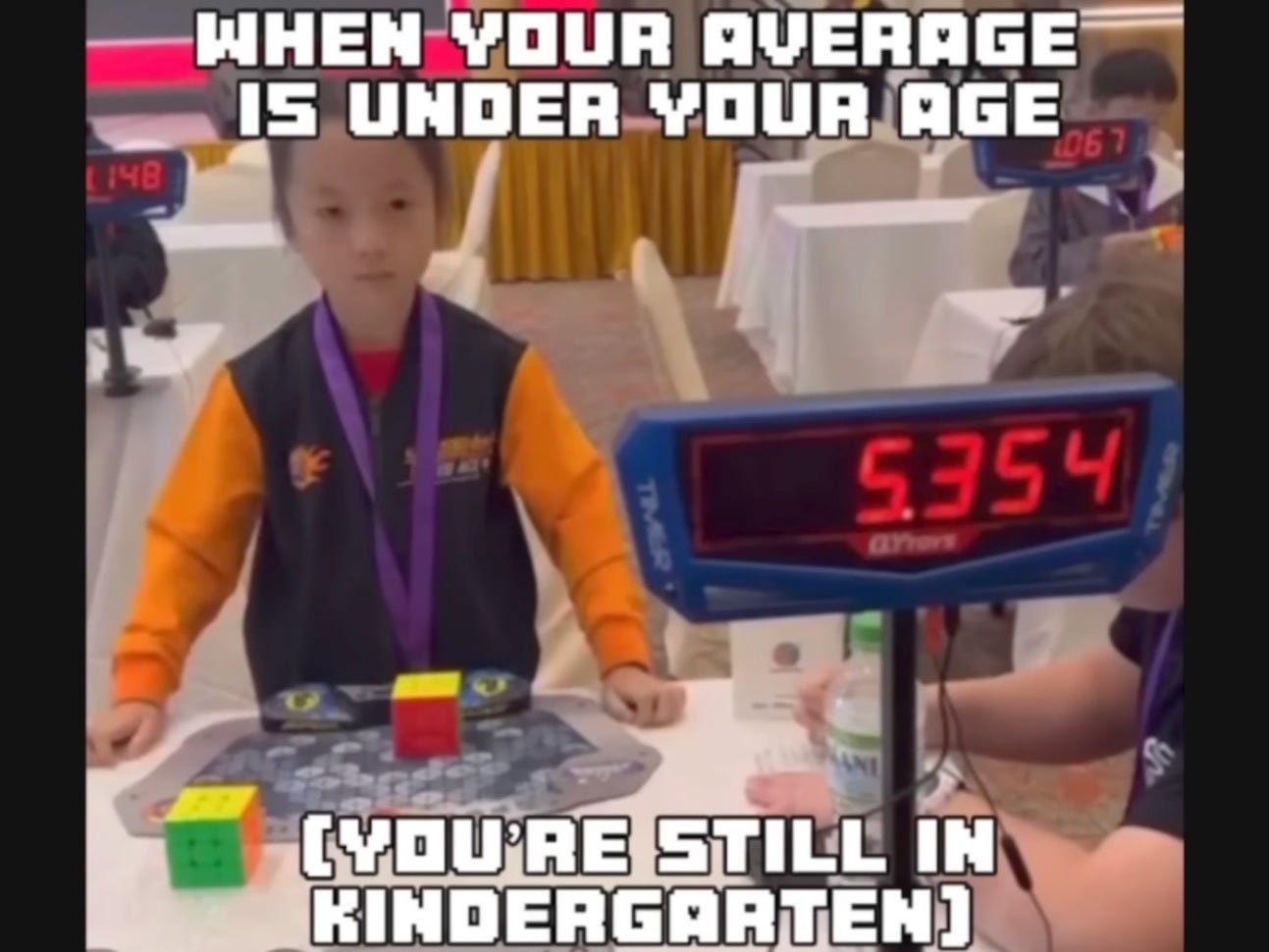
My Training Blueprint
This is my training blueprint if I were to do it myself. This entire article was just a bunch of pieces and things to learn and how to do it, but when you should do it is equally, if not more, important than what to learn. I would try to teach 1LLL + 2-sided recog, but this blueprint can be applied to ZB as well. The approximate ages will be mentioned, but think of this in stages.
Stage 1 (3-3.5): Training the Athlete, Not The Cuber
The goal here is to make the brain and fingers ready for top-level cubing. I would work on finger dexterity with toys such as Legos, building blocks, train tracks, and of course a cube. This also goes hand-in-hand with hand-eye coordination, spatial reasoning, pattern recognition, and memory games. This primes the skills needed to be able to master fingertricks and the basics fast.
In terms of cubing-related training, I would give them a few different cubes, such as a 3x3, 2x2, pyraminx, and clock to play with. The Pyraminx is a different shape, which increases interest in cubing and turning the puzzle, and the clock has pins and dials that also offer auditory stimulation. They can pick it up whenever they want, and can figure out how the pieces move and have full reign of exploration. At this stage, basic fingertricks such as home grip can be taught, and intuitive daisy -> cross work can be done. If they want to learn more, try to teach them how to do the first layer of the beginner method. I would also have them watch fun cubing content as well as childhood TV shows. Showing solves by Yiheng, Xuanyi, Matty, Tymon, world records, or championship finals to inspire and interest the child in the sport more.
Stage 2 (3.5-4.0): Learn CFOP
Here, I would start structured sessions, learning the beginner method and quickly getting under a minute or even 50 seconds. As soon as the 50-ish-second barrier is hit, I would immediately teach them CFOP. I will teach F2L intuitively and have them understand what’s going on, like the cube is a second language. Cube notation, planning cross, and recognition flowcharts will be important at this stage. This will help them reach around 40-45 seconds, which is when they will learn 4-look last layer. Around this time, they would experience their first competition but not compete in it. My goal for their first competition is either a sub15 or a sub10 average. The end goal of these 6 months is to learn full OLL and full PLL while being able to plan cross consistently. The speed should be around sub20 or even sub15, which is when I would see guidance from more experienced coaches.
Stage 3 (4.0-4.5): Mastering CFOP and Intro to ZB
At this point, lookahead and prediction are the number 1 priority, including OLL to PLL transition. Turning speed will be improved through OLL and PLL time attacks. To help with better lookahead and prediction, the child will be taught advanced and efficient F2L solutions, multislotting, pseudoslotting, influencing free pairs, and more optimal fingertricks. This will ideally get them to sub8 or even sub7. Here is when they will compete in their first, second, or third competition. I would focus on mitigating nerves and fixing mistakes from the competition.
After the child can predict cross+2 and have perfect OLL to PLL transition, I would introduce ZB through COLL. After that, they will learn T, U, and L sets and learn Baum-Harris recognition.
Stage 4 (4.5-5.0): Full ZB and 1 Look F2L
Now, 1 looking F2L becomes a daily drill while also finishing full ZB and pushing recognition. Comps would be happening once or twice a month. Solves will be analyzed by a team of coaches, and every minor mistake will be worked on. There is not much else to work on here since these are very difficult concepts and skills.
Stage 5 (5-6): 1LLL
At this point, sub5 or even sub4 solves will be normal, but to push the limit even more, we can add on the rest of 1LLL. This entire year is spent learning and training the subsets of 1LLL through optimizing algs, alg trainers, and optimizing 2-sided recognition. Half of the 1LLL training time is learning algs, and the other half is drilling algs.
While this is going on, ZB will be refined to prevent regressions, and competitions will be every 2 weeks at the minimum. At the end, with full 1LLL learned with recognition being optimized, we will evaluate which method is better for the child. If 1LLL is lacking by a large margin, we would go back to ZB. If 1LLL is better or slightly worse, we will train 1LLL specifically to Xuanyi-level recognition and 2-looking solves. If 2-look becomes easy, we optimize to predict a few pieces of last layer. But that is a long way off, and highly unlikely, but the right child with the right talent and the right motivatiti can do it.
Conclusion and Final Notes
This article is not a prediction of what will happen. It is my take, from a lot of research and speaking to top solvers, and a bit of my own delusions. This might be possible. It might not be.
This can be used as a potential blueprint to produce the next world champion. However, there are too many things that this guide does not account for: genetics, motivations of the kid or parents, finger injuries, life events, burnout, and luck. World-class performance comes from a bunch of factors combined with skill coming together. The speeds mentioned here are under ideal conditions and general predictions.
This blueprint can also be modified and changed for any other area of interest, whether it be violin, math, chess, programming, or even something like an event in cubing like Pyraminx, Skewb, 2x2, Square-1, or even the new FTO.
To summarize this in a few sentences, the key to world-class is not a million solves. It is the right environment, master the fundamentals, optimize only at the end, learn from people better than you, and do deliberate practice. Most important of all, start as early as possible.