


Editor’s Note: This is the first installment of a four-part series by Nishkal Pandya. Members can also read the complete article as one piece, along with unreleased notes from the author, in our exclusive section.
The views expressed are the author’s own. This article presents the author’s personal training philosophy and an intentionally extreme thought experiment. It is not professional child-development advice. Any training involving a young child should remain voluntary, enjoyable, age-appropriate, and responsive to the child’s health and well-being. If the child no longer wants to participate, the training should stop.
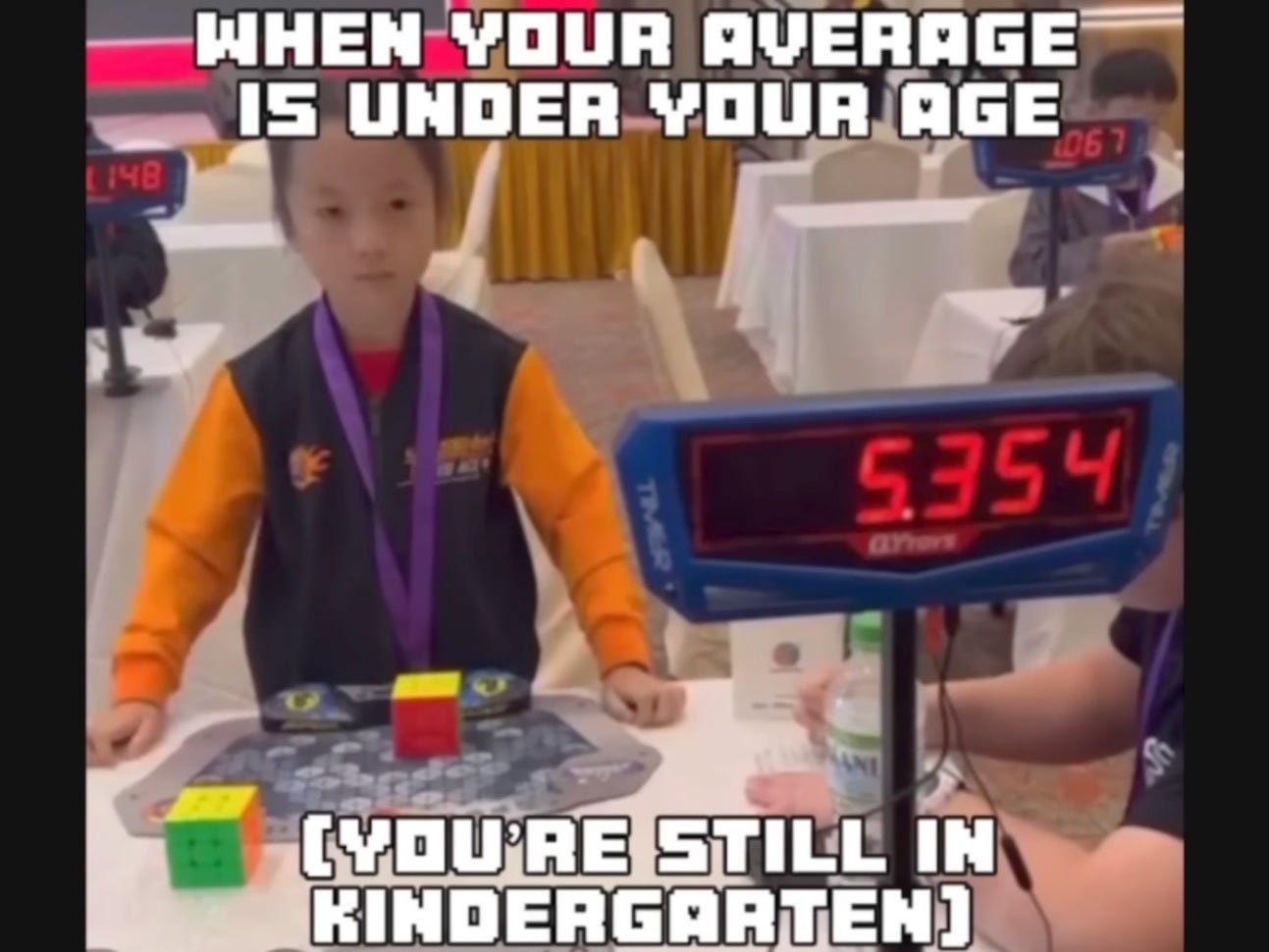
Every day, it feels like another 5-year-old in China knows full ZB and is faster than you.
Over the past few years, Asia has steadily taken over the top of competitive speedcubing. More and more of the world’s fastest solvers are kids, coming from highly structured cubing schools. North America has fallen behind.
How could this system be replicated by a cuber who has a younger sibling or a kid? The kid has supportive parents, access to coaching, and a whole lot of time.
Despite what many would think, I wouldn’t start by teaching them how to solve a cube.
Age Matters, but It Is Not Everything
How is it that the Chinese kids are so fast? They start young. As you have probably heard by now, children’s brains are built to absorb information like a sponge. At that age, the child is forming neural pathways and learning new things. Repeating skills strengthens the neural pathways, making recognition and execution second nature. Instead of thinking, “This is a T-Perm,” they just recognize the case instantly. This also applies to fingertricks and prediction. Their working memory is also more subconscious than adults, so they can learn faster, allowing them to pick up large algsets or learn prediction faster.
Adults can absolutely become world-class, but almost all the top cubers started when they were teenagers or kids, when they had a lot of time, and their brains were more plastic to learn stuff. When you are an adult, you have the ability to be conscious about your practice, self-analyze, and are disciplined to put in the work to do targeted practice. But you are busy all the time. You have work, bills to pay, and maybe even a family.
Kids these days have a coach watching their practice regularly to make them put in the targeted practice, and they have infinite time. This is why it is important to start training cubing young with coaching to be world-class.
Environment Before Skill
Why the Chinese?
China’s dominance was not an accident. They built a system that finds the naturally talented and trains them to be at the top of the rankings. People can claim talent, but there is little evidence that shows Chinese children have any biological advantage over children in North America. The gap can be explained by 3 things: scale, culture, and infrastructure.
Due to the large population of China (1.4 billion), there is a larger number of people with natural talent. More kids will pick up a cube, and that means more talent will emerge.
Structured extracurricular training is much more culturally prevalent in China, often with a long-term, performance-based mindset.. The parents will hold the children accountable and help them practice. Tutoring and structured coaching in all aspects is so rampant that the government tried to BAN it. In the context of cubing, it is treated like learning an instrument or learning chess.
In North America, cubers will improve based on YouTube tutorials, vibes, and random “aha!” moments they pick up from other people. The Chinese kids are raised in an environment designed to make them improve and learn as fast as possible. There are schools dedicated to cubing, which provide daily coaching, internal competitions, and homework/training routines to do at home. There is no guesswork because everything is figured out for you.
The Education System
Let’s talk a little about how China trains its cubers. In some regions, students are introduced through classes in school. The ones that show interest or potential continue to the cubing academies, where the training is structured. Students get daily coaching, specific feedback, and training to do at home to target specific weaknesses.
These academies are led by former top cubers. Around Yiheng’s 4.69 WR average, he had 4 coaches, and they are some of the most popular ones in China. Guojie Wang, a sub-9 solver, has coached over 2,000 students and has taught 7 kids under the age of 3 to solve a cube. Jiayu Wang, who was the Moyu Sponsorship Coordinator, a 2017 Chinese Championships podium finisher, and a competitor on a TV show called The Brain, is a sub-8 solver. Yinghao Wang, another sub-9 solver who also appeared on The Brain, has held many ASRs and eventually became an official GAN tutor. Yinghao was his main coach. Most sports have a team of specialists for the top of the top. The Chinese saw that and applied it to children playing with plastic toys.
Their system is more encompassing than just individual coaching. Cubing schools, organizations, and even the government organize competitions and boot camps to give cubers opportunities to practice competing and managing nerves. This also has an additional benefit of faster solvers inspiring others, which also leads to improvement via proximity.
Role of Parents
The coaching is helpful, but a young child is not capable of being disciplined enough to implement feedback and do targeted practice. They just want to do what is fun to them, and normally, it is to do more solving. This is where the parents come in. Parents help maintain a training schedule, encouraging them, managing transportation, and more. The support of parents is so important that Jiayu Wang said, “The biggest factor that determines if a kid is going to be good is how involved the parents are.” So a kid that is going to be world-class needs to have supportive parents who are either coaches or willing to pay for coaching from that age. The parents should also be well-versed in cubing so they can give small pointers and understand what their child is doing. The parent also has to make sure the kid enjoys the act of cubing and doesn’t drop it because it got too hard or they lost interest.
Could North America Replicate It?
The short answer is not really. There is no comparable system like there is in China. However, they do not need to copy the infrastructure to use the principles.
If I were raising a future world champion, I would focus on the coaching and parental/family support. I would coach the kid myself until they get to a sub-30 or a sub-20 level. Then, I would get professional coaching from one of the North American coaches, such as Dylan Miller, Luke Greisser, or Caiden Lee. If I have the connections, I would work with a Chinese cubing coach. At this point, they will learn new stuff to work on, and to help them stay consistent, I would train with them and treat cubing as a bonding activity that is also an intense competitive discipline. We would make a training schedule together and do targeted practice during that time. After that time, we should work on doing 100 solves every day. After they are sub-7, I would transition to trying to get them into Matty’s Elite Cubing Initiative and use that to contemplate the next steps/things to work on.
I would also start taking them to competitions with me to gain exposure and meet faster cubers, which gives them motivation to improve and be like them. They should ideally visit, spectate, and talk with new people at around 2-3 competitions before their first comp to help reduce nerves and help them make friends. The environment and the people involved are the most important things that determine success. The other stuff, like hardware, talent, and effort, are secondary priorities before and throughout the journey.
