



The final day of the 2026 WCA European Championship ended with Teodor Zajder becoming the European 3x3 champion and Poland completing one of the most dominant continental championship performances in recent memory.
Zajder recovered from an uneven opening to the competition to win both 2x2 and 3x3. Tymon Kolasiński added another title in 5x5, Adrian Dębski delivered a last-solve victory in 3x3 Blindfolded, and Michał Krasowski upset the community favorite in Square-1.
Poland finished Euros with 11 gold medals and 17 total medals, leading every country by a wide margin.
Teodor Zajder Wins the European 3x3 Championship
Teodor Zajder won 3x3 with a 5.46 average, finishing ahead of Valerio Locatelli and Tymon Kolasiński.
European Championship Podium
🥇 Teodor Zajder (Poland) - 5.46
🥈 Valerio Locatelli (Italy) - 5.74
🥉 Tymon Kolasiński (Poland) - 5.90
Zajder’s final solves were 5.80, 4.82, (4.73), (7.00), and 5.75. His opening three attempts established the lead before the 7.00, briefly giving the remaining contenders an opportunity. Teodor appeared unsatisfied after his 5th solve.
Kolasiński had entered the final as the top seed after recording a 4.92 average in the semifinal. Kim Roger Haraldsen followed with a 5.06 Norwegian record, while Zajder advanced third at 5.08.
That seeding order meant Zajder completed his final before the last pairing of Haraldsen and Kolasiński, putting a 5.46 on the board for the rest of the field to chase.
Kolasiński encountered trouble early in the final, including an apparent cross mistake, and recorded two six-second solves within his first two attempts. A 4.34 on solve four kept the title within reach, but he needed approximately 4.90 or faster on the final attempt to pass Zajder.
His last solve was visibly shaky and ended at 6.56, confirming Zajder as the European champion.
The title completed a major recovery for Zajder. He appeared nervous during the Nations Cup Relay on Day 1 and recorded the DNF that eliminated Poland in the semifinal. His opening 2x2 round was also below expectations, but he recovered to win that event on Saturday before taking the biggest title of the championship on Sunday.
Valerio Locatelli delivered one of the biggest surprises of the championship, recording a 5.74 average to earn silver behind Teodor Zajder. He entered the final as the No. 12 seed and did not appear among the community’s top five podium predictions, which instead centered on Tymon Kolasiński, Zajder, Luke Garrett, Timofei Tarasenko, and Olaf Kuźmiński.
Locatelli responded with one of the cleanest sets of the final, recording (6.45), 6.24, 5.39, (5.25), and 5.59. His consistency separated him from Kolasiński and Garrett in the race for second, prompting a huge celebration from the Italian supporters as the unexpected silver medal became secure.
The road to the final also produced several notable results. Haraldsen’s 5.06 set a Norwegian record and earned the second seed. Daniel Rush recorded a 3.82 African continental record single earlier in the event, while Patrick Ponce and Chris Mills were among the recognizable names who did not survive the final cut.
Zajder entered Euros as the community’s second choice behind Kolasiński. The final reversed that order and gave him his second championship of the weekend, and made Teodor the new face of 3x3 in Europe.
Tymon Kolasiński Completes the Big-Cube Sweep
Kolasiński won 5x5 with a 35.38 average, completing a sweep of the four largest standard cube events at Euros.
Final Podium
🥇 Tymon Kolasiński (Poland) - 35.38
🥈 Richard Delacoste (Switzerland) - 41.82
🥉 Ciarán Beahan (Ireland) - 42.10
Kolasiński’s solves were 35.92, 35.65, (31.54), (38.10), and 34.56. Every one of his attempts was faster than the best solve recorded by either of the other medalists.
The result was the most expected title of the championship. Kolasiński received 97% of the first-place picks in the community prediction challenge, with every ballot placing him somewhere on the podium.
Delacoste finished second despite every solve in his set being slower than the one before it. He opened with a (37.90) before recording 40.32, 41.70, 43.44, and (43.96). The gradual decline did not matter, as his early speed gave him enough room to secure silver.
Beahan’s final began with a major cube pop that resulted in a DNF. He responded with four completed solves, including a 39.19, and recovered to take bronze with a 42.10 average.
Patrick Ponce entered the last solve within reach of the podium. A 43.21 or faster would have moved him ahead of Beahan, but his 47.14 forced a 45.58 to count and left him fourth at 42.89.
Kolasiński leaves Euros with titles in 4x4, 5x5, 6x6, and 7x7. He also lowered the 7x7 European record in both rounds and came within 0.09 seconds of his 4x4 world record during the opening day.
His 3x3 bronze prevented a complete sweep of the standard cube events, but four golds and one bronze still made him the most decorated individual competitor of the championship.
Adrian Dębski Wins 3BLD on the Final Solve
Adrian Dębski won 3x3 Blindfolded with a 16.11 personal-record single, moving into first place on the fifth and final attempt.
European Championship Podium
🥇 Adrian Dębski (Poland) - 16.11
🥈 Jens Haber (Germany) - 16.28
🥉 Charles Daloz-Baltenberger (France) - 16.47
The final remained open until the final sequence of solves.
Simon Praschl led through the first four attempts with a 17.18. His fifth solve ended in a DNF, but that initially appeared survivable until the other leading competitors began improving.
Haber recorded a 16.28 on his final attempt. Daloz-Baltenberger followed with a 16.47, and Dębski completed the comeback with a 16.11.
All three medalists recorded their best result on solve five.
Several other competitors also entered the final scramble with realistic podium opportunities. Iker Carrasco Ruiz finished with a sub-16 attempt that resulted in a DNF, while multiple other leading competitors also failed their last solves.
Dębski’s result continued a remarkable pattern on the European stage. At the previous European Championship, he also secured the title on his final solve, recording a 17.50 personal record. This time, he repeated the finish with an even faster result.
As the 16.11 was confirmed, the Polish team rushed toward Dębski to celebrate another title in what had already become a historic championship for the country.
Praschl dropped from first to fourth despite leading for most of the final.
Michał Krasowski Upsets the Square-1 Favorite
Michał Krasowski won Square-1 with a 5.63 Polish record average, defeating community favorite Rasmus Stub Detlefsen.
Final Podium
🥇 Michał Krasowski (Poland) - 5.63 NR
🥈 Rasmus Stub Detlefsen (Denmark) - 5.88
🥉 Vincent Chan (Netherlands) - 6.05 NR
Krasowski recorded solves of 5.41, (6.79), 6.16, 5.33, and (5.14). His fastest solve came on the final attempt and completed the national record.
Detlefsen entered as the strongest favorite in the community predictions, receiving 83% of the first-place selections. He remained in championship position until the final solve.
His last attempt was originally stopped at 5.51 but received a two-second penalty, making the result 7.51. That forced another slower solve to count and left him with a 5.88 average.
Without the penalty, his average would have been approximately 5.57, enough to defeat Krasowski by 0.06 seconds.
Chan also delivered his fastest solve on the final attempt, recording a 5.18 to secure bronze and a 6.05 Netherlands record average.
The final produced two national records and a title decided directly by a last-solve penalty.
Milan Vincent Andric Wins Pyraminx Overall, Jakub Majchrzak Takes the European Title
Milan Vincent Andric won the Pyraminx competition overall with a 1.40 personal-record average.
Because Andric represents the United States, the European title went to Jakub Majchrzak of Poland.
European Championship Podium
🥇 Jakub Majchrzak (Poland) - 1.75
🥈 Alexey Tsvetkov (Russia) - 1.77
🥉 Aratz Larruzea (Spain) - 1.82
Andric’s solves were (1.12), 1.31, 1.55, (2.18), and 1.34. His final 1.34 completed an extremely consistent set and left him 0.35 seconds ahead of the overall field.
The European championship battle was much closer.
Majchrzak closed with a 1.35, his fastest solve of the round, to finish at 1.75. Tsvetkov entered the final attempt with a chance to take the championship but recorded a 4.14, forcing a 2.21 to count and dropping his average to 1.77.
That left Majchrzak ahead by just 0.02 seconds.
Larruzea, the community’s pre-competition favorite, finished third among eligible European competitors with a 1.82.
Oisín Olwill produced one of the event’s biggest earlier-round results, recording a 1.57 Irish record average to win the semifinal. His final was more difficult, and he finished outside the championship podium.
The result gave Poland another championship title, even though the fastest competitor in the room represented another continent.
Final Euros 2026 Medal Table
The table counts European Championship medals rather than overall competition placements. Andric’s Pyraminx victory is therefore not counted for the United States, with Majchrzak receiving the European gold.
Nations Cup Relay is excluded. FMC awarded two silver medals and no bronze because of the tie for second.
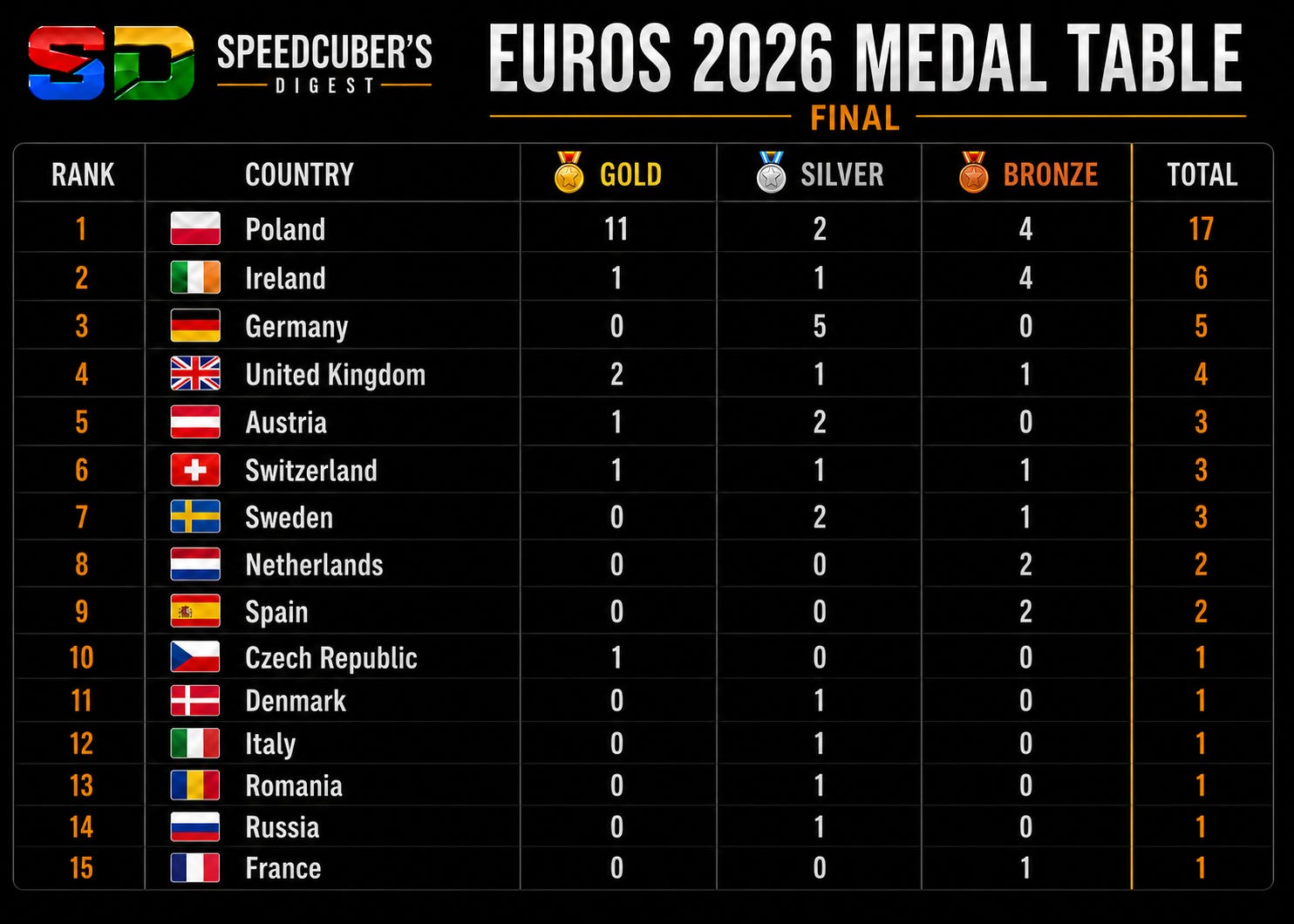
Poland won 11 of the 17 official European Championship titles and earned a medal in every standard cube event.
Kolasiński led the individual medal haul, while Zajder’s final-day victories in 2x2 and 3x3 gave Poland both the opening and closing titles of the championship’s final weekend.
Ireland finished second by total medals with six, led by Stephanie Rose Martin’s Megaminx championship and three big-cube bronze medals from Ciarán Beahan.
Germany finished with five silver medals but no golds. Its championship was defined by repeated runner-up finishes from Sebastian Weyer, Mark Zimmermann, Moritz Lotz, and Jens Haber.
Euros began with Poland’s Nations Cup disappointment and questions about whether the country’s control of the psych sheets would translate under pressure.
Four days later, the answer was clear.
Poland did not simply lead the championship. It controlled it.
Poland is on Fire!