


Day 2 of the 2026 WCA European Championship delivered the first official event titles of the competition, with several community favorites immediately converting expectations into championships.
Tymon Kolasiński won both 4x4 and 7x7, Nicholas Archer claimed One-Handed, Antoni Stojek completed an emotional comeback in Clock, and Simon Praschl won Multi-Blind.
International competitors reached every completed final except Clock, but the podiums remained entirely European through the end of Day 2.
Tymon Kolasiński Wins 4x4
Kolasiński won the 4x4 title with a 20.24 average, finishing ahead of Sebastian Weyer’s 20.94 and Twan Dullemond’s 22.53.
Final Podium
🥇 Tymon Kolasiński - 20.24
🥈 Sebastian Weyer - 20.94
🥉 Twan Dullemond - 22.53
Kolasiński’s final solves were 21.40, (18.58), (25.25), 18.30, and 20.75. The average was slower than his near record-level 18.65 from the opening round, but it was enough to win the title by 0.70 seconds.
The community entered Euros overwhelmingly expecting this result. Kolasiński received 88% of the first-place picks in the Speedcuber’s Digest Podium Prediction Challenge and appeared on every submitted 4x4 podium.
The battle for bronze came down to the final attempts. Ciarán Beahan entered solve five with a realistic opportunity to pass Dullemond, needing a 23.07 or faster to move ahead. His 26.20 left him fourth with a 23.02 average.
Luke Garrett’s 27.14 forced his opening 26.75 to count, dropping him to sixth at 24.23. Even with the fastest possible fifth solve, however, his best possible average was 22.82, meaning the podium was already mathematically out of reach.
Dullemond’s third-place finish continued an excellent opening two days after he delivered the decisive solve in the Netherlands’ Nations Cup Relay victory on Thursday.
Two Rounds, Two 7x7 European Records
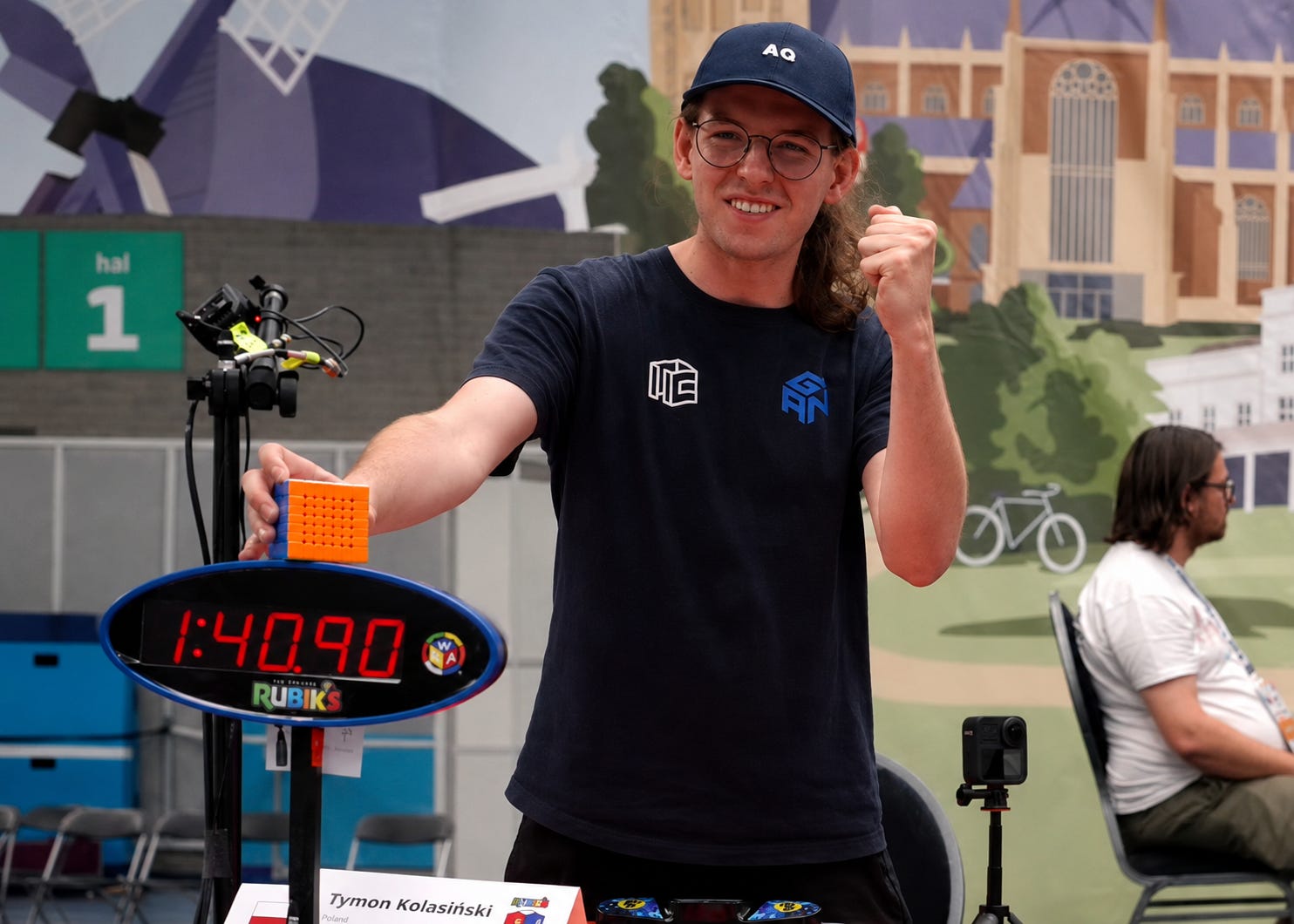
Kolasiński followed the 4x4 title by winning 7x7 with another European record mean.
His final times were 1:44.09, 1:39.94, and 1:40.90, producing a 1:41.64 mean. The result completed a remarkable championship progression in which he lowered the continental record in both rounds.
Final Podium
🥇 Tymon Kolasiński - 1:41.64 ER
🥈 Mark Zimmermann - 1:48.26
🥉 Ciarán Beahan - 1:51.05
Kolasiński entered Euros with a 1:42.18 European record, lowered it to 1:42.14 in the first round, and finished with the 1:41.64 in the final.
That left him more than six seconds ahead of Mark Zimmermann, who delivered a breakout performance of his own.
Zimmermann recorded a 1:41.89 German record single on his third attempt, securing both the national record single and a 1:48.26 national record mean. The single moved him close to the top 10 globally and arrived when he needed it most to secure silver.
Kate Grahame also recorded a 1:55.19 personal-record mean. This breaks her own Female World Record in the event.
Daniel Rush finished fourth with a 1:54.22 mean, continuing a strong championship across the larger cubes.
Timofei Tarasenko remained absent on Day 2. Tarasenko had been expected to challenge Kolasiński across the big cubes and was among the community’s leading podium selections in 5x5, 6x6, 7x7, and Megaminx.
Nicholas Archer Survives Tense One-Handed Final
Nicholas Archer won 3x3 One-Handed with an 8.76 average, finishing ahead of Ianis Costin Chele and Eden Robinson-Rechavi.
Final Podium
🥇 Nicholas Archer - 8.76
🥈 Ianis Costin Chele - 9.13
🥉 Eden Robinson-Rechavi - 9.34
Archer entered the final after matching his 7.95 European record average during the opening round. The final was slower and visibly more difficult, but his early consistency gave him enough room to survive.
His solves were 8.42, 8.65, (8.22), 9.21, and (10.94). Archer’s hands were visibly shaking before the fifth attempt, and the 10.94 became his worst solve of the set. By then, however, the title was still within reach.
Juliette Sébastien had the clearest late opportunity to take the lead. She entered solve five with a chance to pass Archer, but a 10.45 forced her to count a slower result and dropped her to sixth with a 9.50 average.
Luke Garrett, the current world record holder, and Patrick Ponce, a former world record holder, both suffered costly solves early in the final and never recovered into podium contention.
The podium was nearly a complete Roux sweep, but Chele’s silver prevented Archer and Robinson-Rechavi from producing an all-Roux top three.
The community had viewed One-Handed as the closest title race of Euros. Archer and Garrett each received 42% of the first-place predictions, with Archer ultimately delivering the win.
Antoni Stojek Completes Emotional Clock Comeback
Antoni Stojek won Clock with a 2.77 average, completing one of the most emotional victories of the championship.
Final Podium
🥇 Antoni Stojek - 2.77
🥈 Jack Corr - 3.11
🥉 Caleb Wolf Dunn - 3.26
Stojek’s solves were (2.40), 2.62, (4.16), 2.57, and 3.11. Entering his final attempt, he needed a 3.97 or faster to guarantee the title. He delivered a 3.11 and immediately erupted in celebration.
His father and members of the Polish community celebrated from the crowd as Stojek broke down in tears.
The victory carried added meaning because of what happened at the 2025 World Championship.
Stojek was initially declared the Clock world champion, but a post-round review determined that one of his attempts had been misscrambled. The solve was converted to a DNS, changing his average to 3.12 and moving him from first to third.
Brendyn Dunagan also had an attempt converted to a DNS in the same final, although his second-place position was unaffected. The finalized podium placed Volodymyr Kapustianskyi first.
The incident became one of the most discussed Clock controversies of the past year and has remained part of the broader community conversation surrounding the event.
This time, there was no later reversal.
In his interview, Stojek credited Poland’s speedcubing community for continuing to push and support him. He said the group wants every member to succeed, and that their support has kept him moving forward.
The community had selected Stojek as the clear Clock favorite, giving him 62% of the first-place predictions. He delivered the title that many believed he had already earned on the World Championship stage.
Simon Praschl Wins Multi-Blind
Simon Praschl won 3x3 Multi-Blind with a result of 52 points from 57 cubes in 58:53.
Final Podium
🥇 Simon Praschl - 52/57 in 58:53
🥈 Adrian Dębski - 43/48 in 1:00:00
🥉 Mikołaj Morawski - 39/41 in 57:07
Praschl separated himself clearly from the rest of the field, finishing nine points ahead of Dębski.
The result also overturned one of the community’s stronger predictions. Krzysztof Bober received 64% of the first-place selections and entered as the clear favorite, but both of his attempts included too many missed cubes to contend for the podium.
Bober opened by solving 48 of 61 cubes in 1:00:02. Although he completed more cubes than anyone outside Praschl, the 13 misses reduced the attempt to 35 points. His second attempt was 40/60 in 1:00:02, which produced only 20 points.
His aggressive cube counts gave him championship-winning potential, but they also created much more risk than the attempts from the eventual medalists. Bober finished sixth, while Praschl combined a similarly ambitious total with much greater accuracy to secure the title.
Teodor Zajder Opens 2x2 Below Expectations
Teodor Zajder entered Euros as the top-ranked 2x2 competitor and received 72% of the community’s first-place predictions, but his opening round was more difficult than expected.
Zajder recorded solves of 1.78, 1.12, 1.80, (0.96), and (3.22) for a 1.57 average, placing 20th in the round.
The uneven set followed his Nations Cup Relay DNF on Day 1, where visible nerves helped eliminate favorite Poland in the semifinal.
One difficult opening round does not remove Zajder from contention, but his start contrasts sharply with Alexey Tsvetkov’s round-leading 1.14 and Christian Crea’s 1.23 Italian record.
FMC Enters Final Attempt With a Crowded Title Race
Fewest Moves has completed two of its three attempts, with Louis-Marie Ratto and Oliver Fritz sharing the provisional lead.
Both competitors recorded 21-move solutions on the opening two attempts, giving them 21.00 means entering the final solve.
Krzysztof Pietrusiak sits alone in third at 21.50 after solutions of 22 and 21 moves. Seven competitors are tied behind him at 22.00.
Ratto and Fritz control the title race. Another 21-move solution would give either competitor a 21.00 mean, while a 22 would produce a 21.33.
Pietrusiak would need a 20 on the final attempt to finish with a 21.00 mean. A 21 would give him 21.33, keeping him in strong podium contention but leaving him dependent on the leaders’ results.
Radomił Baran, the community’s pre-competition favorite, sits 15th provisionally with a 22.50 mean after attempts of 23 and 22. He likely needs one of the strongest final solutions in the field to return to title contention. A 19 would give him a 21.33 mean, while a 20 would leave him at 21.67.
Adam Marcellus Kelly and Adrien Neveu, who ranked second and third in the community predictions, are tied at 23.00 after opening with matching 23-move solutions. Both would likely need a sub-20 final attempt and help from the leaders to reach the podium.
With two competitors tied at 21.00 and eight more within one move of the lead, the third attempt will decide nearly everything. Ratto and Fritz hold the advantage, but one exceptional solution could still reshape the entire podium.