


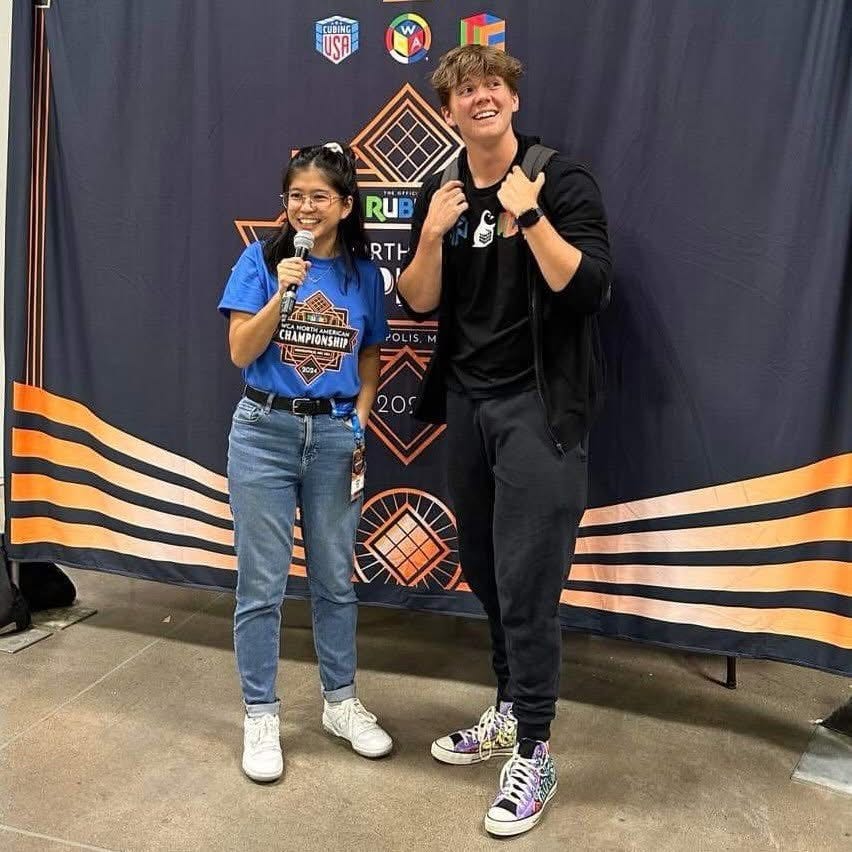
There are no half measures with Luke Griesser. In the Kentucky cuber’s world, his failures are as spectacular (and important) as his successes. One need only look at his results in national competitions: he was not even in the top 10 in 2023, but his results since have kept him in a contending spot as one of the best in the United States. His most recent major victory came in Port Huron, MI, when he beat Dylan Miller to claim his first win in the Premier Speedcubing League. His emotive reactions have, for better or for worse, made him one of the most entertaining characters of the speedcubing world this decade.
But get him outside of the competition, with the cameras off and the sun setting slowly on a Monday evening, and you’ll find a solver wise beyond his years. The man who once practiced solves like it was as essential as breathing has grown up into a perpetual student of the game, one who knows when it’s time to work hard just as well as when it’s time to ease back. For Griesser, the lesson has been learning how to control that intensity, not lose it.
“2023 was the most disciplined I’ve ever been with cubing,” Griesser said. “It was two hours every day, ZBLLs during science class, that type of thing… I definitely picked the right time to be the most disciplined, because that sort of discipline led to a bad result, which made me believe that sort of discipline shouldn’t be the answer all the time.”
That dedication to his craft, although beneficial to his growth as a solver, led to unintended consequences outside the speedcubing world, which, according to Griesser, ended up causing him to be perceived in a negative way.
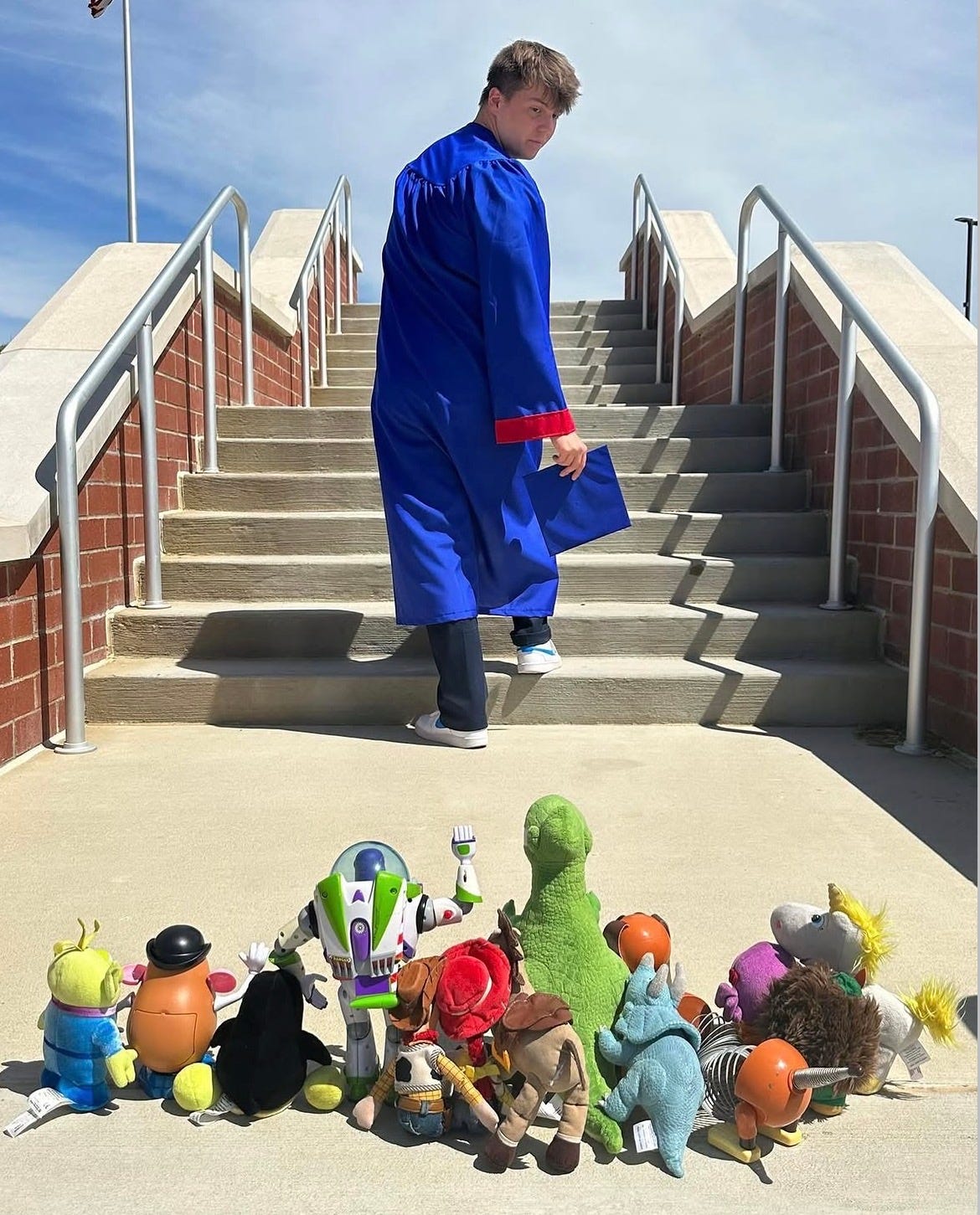
“Whenever I was not cubing in 2023, that sort of discipline would come off to other people in my life as arrogant, or some other negative personal trait. I think it’s not crazily inaccurate to say that thinking I had to be the most disciplined person in the world made other people think, ‘he’s not really someone who’s easy-going or fun to be around.’”
Besides those perceptions, Griesser also noted that his more obsessive nature around this time drove him to relentlessly practice his solves, even if it was hurting his ability to develop as a cuber.
“When you start cubing, and you can’t stop, [when] you zone out and lose track of time, you can get caught in something like that. And that’s good if you love what you’re doing; when you zone out, and you’re like, ‘oh, I’ve been doing this for two hours, and I haven’t even noticed,’ that’s a good thing. It’s not a good thing to cube for eight hours every single day, then take a 30-minute break, then cube for eight more hours, then go to sleep. That is not only not good for your mental health, it’s not even productive.”
“When you lift too much… there’s such a thing as overtraining the muscles. And it will actually stunt progress if you’re in the gym for eight hours a day if you’re a natural athlete… No person who wants to be a pro cuber should be cubing for eight hours every day. If you show up a little bit, and kind of keep your obsession contained, and then let it go in short spurts… I think there’s a healthy way to be obsessed with something.”
Now, as he wraps up his freshman year at the University of Kentucky, Griesser says he has the healthiest outlook of his pro cubing career, along with the equipment and goals to match.
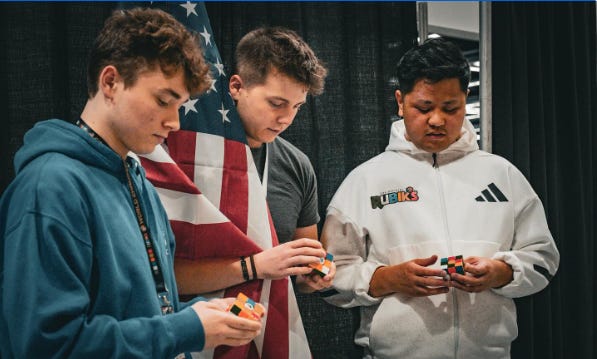
“I honestly don’t think I’ve ever felt better besides immediately after I finished the 5.45 at NAC ‘24. I have four WeiLong V11s on my desk, and all four of them are really good… It’s kind of similar to [University of Arkansas men’s basketball coach] John Calipari’s platoon system when he had 10 NBA players on one team: if you put five NBA players on the court, they’re going to make something happen; if you put a good cube in a good cuber’s hand, something good is going to happen.”
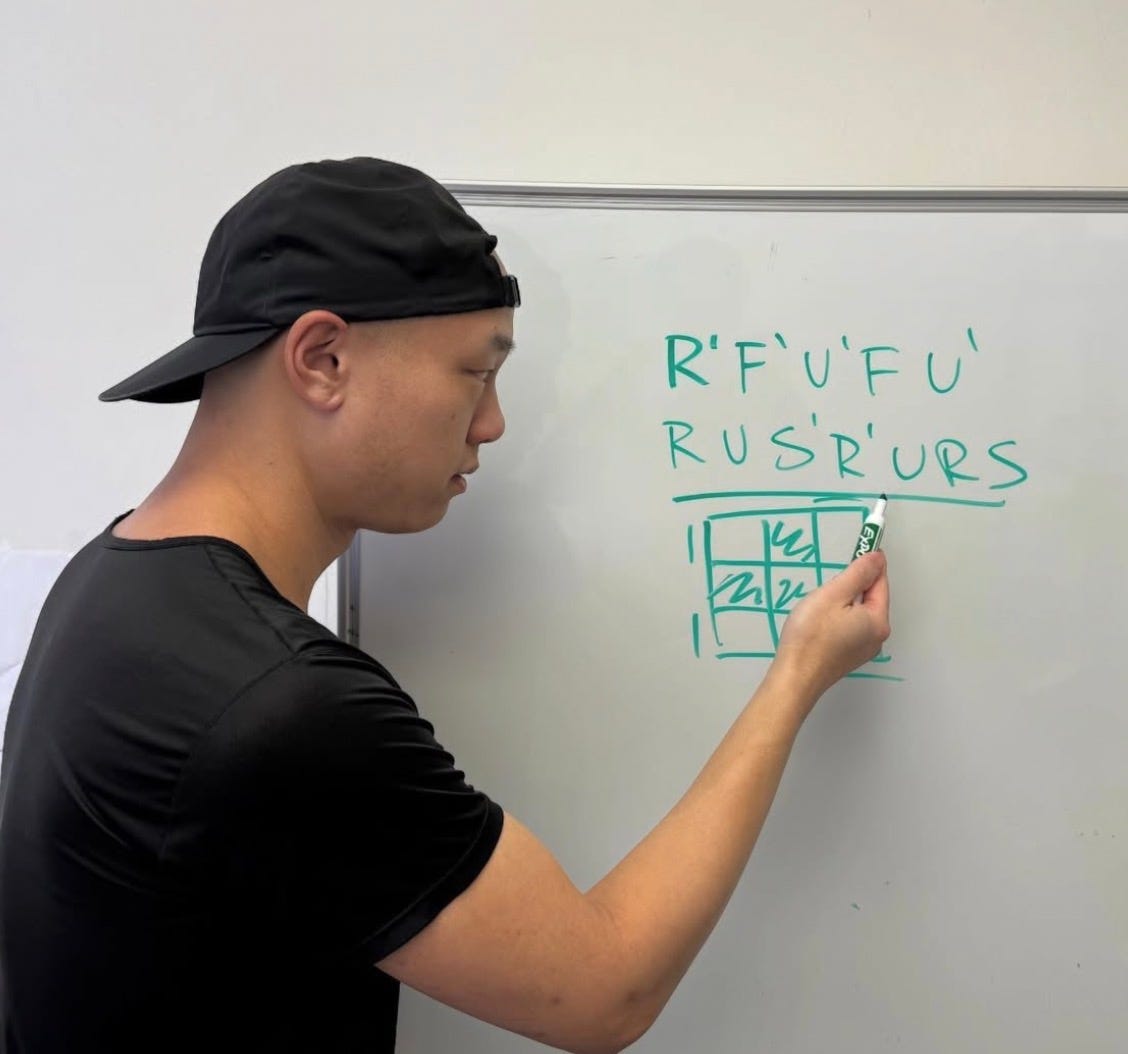
On the subject of coaches, Griesser, who owns cubing.gg, a company that helps newer cubers learn from top-level solvers, has been receiving training from Phil Yu, a founding member of the cubing retailer TheCubicle.
“Phil Yu has actually been coaching me quite a bit recently. I’ve only had two sessions with him… all of the Yiheng stuff, all of the Xuanyi/Qixian stuff, cubing.gg and TheCubicle have them [sponsored], so he’s interacting with them and their parents and their coaches a lot, so he’s able to pick up on stuff that the Chinese kids’ coaches would pick up on. He’s able to explain why what I’m doing is wrong or why what I’m doing is good. So he’s been a big help in everything having to do with cubing.”
Yu’s coaching is a shift from the kind that Griesser received in the past, but he says that it has allowed him to develop a deeper understanding of his solves and how he can translate that understanding into winning results.
“With a puzzle like the Rubik’s Cube, you can always learn more, and that’s kind of what drew me to it in the first place… In terms of coaching, being a student hasn’t really affected the way that I teach or anything. Phil has pointed out things that I just didn’t notice were problems in my solving, and that makes me notice them in other people’s solving. The way that he coaches, he just asks me questions and makes me give the answer to him, and if I give him an answer that’s not exactly what he’s looking for, he’ll ask another question. He doesn’t tell me anything; he asks me questions and makes me look for the answers. That type of thing is very, very effective, especially in a cubing environment.”
According to Griesser, although Yu’s coaching draws heavily upon the kind of techniques that some of the best Chinese solvers in the world use, there aren’t that many differences that he’s seen between the two regions, except for one very big one.
“A lot of it is in person… everything else besides that would be completely speculative. I know that Yiheng was shocked to learn that most of the speedcubers in the US are self-taught and don’t have coaches… that makes me think that the majority of Chinese speedcubers do have them.”
While he continues to both train his 3x3 skills and impart his wisdom on his students, Griesser’s priorities are squarely placed on this summer, where he’s got his eyes set on the biggest title he can claim this year: North American Champion.
“NAC ‘26 is up there… I think that’s the number-one goal that I have… just do well, bounce back from All Stars 2025, which wasn’t my best performance ever. I feel good, especially because of how my solving is looking right now, combined with PSL performance… I’ve only been to one competition this year, and that was my best performance in a competition ever. I guess if you look at it from the perspective of where I was versus where I am now, I’m currently in my prime.”
That prime will be tested in a stacked field at this year’s North American Championship in July, where he will face some of the world’s best solvers, including Matty Hiroto Inaba, Max Park, Dylan Miller, and Luke Garrett. But when Griesser settles down in Raleigh, NC, on that Fourth of July weekend, there’s only one person that he knows he will have to beat.
“Me. But not because the win is mine to lose… It’s me against me, always.”